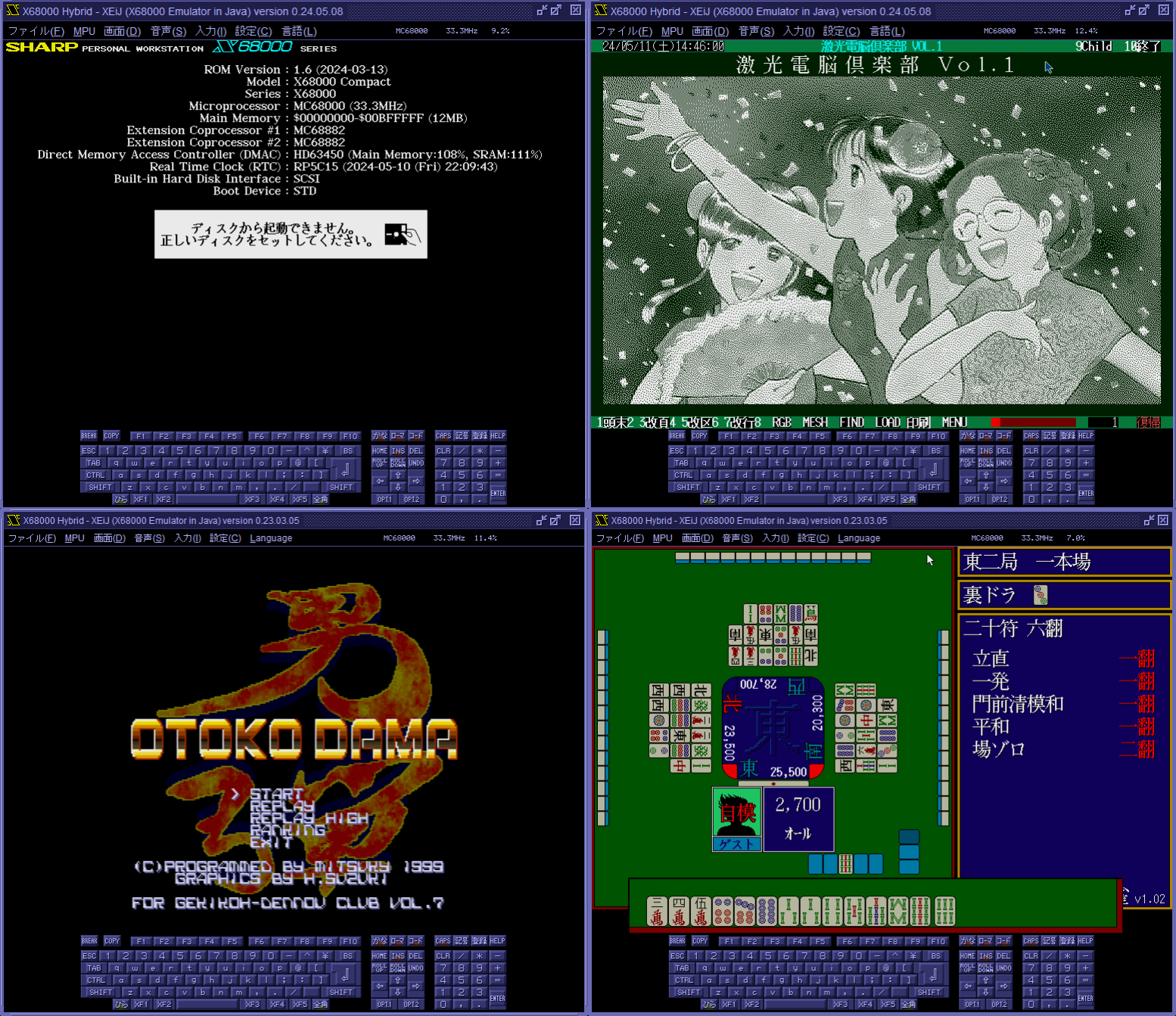


Cet émulateur est également le plus complet des outils de développements X68000 existant aujourd’hui. Il s’agit d’un fork de l’émulateur XM6 v2.05 de PI avec une pléthore de nouvelles fonctionnalités. Les changements sont pour la plupart liés à l’interface utilisateur et un accent a été mis sur le développement et les fonctions de débogage plutôt que sur l’exactitude de l’émulation, cependant il y a suffisamment d’améliorations pour qu’il soit recommandé d’utiliser cette version plutôt que XM6 v2.06 finale.


Les changements:
– When an archive is loaded into the File Browser menus, floppy images co-located
with the archive will now also be added to the relevant menus. They will appear
below the in-archive files. This is convenient because the archive might not
contain all the floppy disk images you require. This behavior is also similar
to the case where typical floppy-only archives are loaded into the media menus.
– SRAM.DAT is now written out in blocks: only modified blocks are actually saved,
thus reducing wear on certain types of storage devices. Remember: you can use
the Tools > SRAM menu to disable the Boot Counter or set SRAM.DAT as read-only,
both of which reduce the frequency at which the file needs to be written to.
– Added a command to run the VM for one millisecond. For shorter periods,
try Skip Ahead. For longer periods, use Frame Advance.
– If the VM is running, disassembly windows will now automatically disable
synchronization when deemed appropriate.
– You can now hold Shift while selecting an item from the Stack menu to view the
stack itself instead of following the value stored on the stack as an address.
– The context menus for disassembly and memory windows are a bit smarter now.
– Completed an extensive review of the CPU emulator.
– Automatic Controller Mode is now more reliable.
– ROM loading is now more fault tolerant.
– SCSI ROMs are no longer required when loading state files made with SCSI VMs.
– SCSI ROMs are no longer being loaded at start unless required by the previously
saved configuration. The SCSI ROM check (if enabled in the settings) is now
being performed in the SCSI page in the options, despite being mostly useless.
(It will still be performed at startup if SCSI ROMs are needed initially.)
– Magneto-optical (MO) drives are now implemented in a way that should be more
compatible with older SCSI ROMs and software. If this results in any problems,
I won’t know about it unless you tell me.
– The Fast Floppy setting now also enables some SCSI tweaks.
(The setting should probably be renamed, or bifurcated.)
– Disassembly windows now have decimal/binary/negative interpretation options.
Non-hexadecimal modes may include special interpretations, such as ASCII
or bitmasks. Refer to the manual for the keystrokes. The registers window
now has a similar feature as well.
– You can now hold Shift while opening the Vectors submenu to show the actual
vector number (which may be dynamic) instead of the vector address’s MSB.
– A few keyboard commands for disassembly/memory windows are now documented.
Notably, Shift-F is a nice feature that doesn’t seem to have been announced.
It was hinted at in the changes for Release 53 but has been around much longer.
Bug fixes:
– SRAM data loss was possible under certain circumstances.
– Fixed a not-so-delightful state-loading bug that was capable of causing data loss or corruption under certain circumstances.
– Corrected many minor defects in the CPU emulator that only experts might notice.
– Resumed MO/CD media were not being detected.
– SCSI VMs were failing to boot on rare occasions.
– Resets were performing certain actions in an illogical order.
– The CPU emulator was processing a particular invalid opcode as if it were valid.
– The operand parsing for MOVEQ in the assembler was too strict.
– Error messages in the assembler were being suppressed inadvertently.
– Fixed a harmless System Port bug.