Cet émulateur est également le plus complet des outils de développements X68000 existant aujourd’hui. Il s’agit d’un fork de l’émulateur XM6 v2.05 de PI avec une pléthore de nouvelles fonctionnalités. Les changements sont pour la plupart liés à l’interface utilisateur et un accent a été mis sur le développement et les fonctions de débogage plutôt que sur l’exactitude de l’émulation, cependant il y a suffisamment d’améliorations pour qu’il soit recommandé d’utiliser cette version plutôt que XM6 v2.06 finale.


Les changements:
 
– When an archive is loaded into the File Browser menus, floppy images co-located
with the archive will now also be added to the relevant menus. They will appear
below the in-archive files. This is convenient because the archive might not
contain all the floppy disk images you require. This behavior is also similar
to the case where typical floppy-only archives are loaded into the media menus.
– SRAM.DAT is now written out in blocks: only modified blocks are actually saved,
thus reducing wear on certain types of storage devices. Remember: you can use
the Tools > SRAM menu to disable the Boot Counter or set SRAM.DAT as read-only,
both of which reduce the frequency at which the file needs to be written to.
– Added a command to run the VM for one millisecond. For shorter periods,
try Skip Ahead. For longer periods, use Frame Advance.
– If the VM is running, disassembly windows will now automatically disable
synchronization when deemed appropriate.
– You can now hold Shift while selecting an item from the Stack menu to view the
stack itself instead of following the value stored on the stack as an address.
– The context menus for disassembly and memory windows are a bit smarter now.
– Completed an extensive review of the CPU emulator.
– Automatic Controller Mode is now more reliable.
– ROM loading is now more fault tolerant.
– SCSI ROMs are no longer required when loading state files made with SCSI VMs.
– SCSI ROMs are no longer being loaded at start unless required by the previously
saved configuration. The SCSI ROM check (if enabled in the settings) is now
being performed in the SCSI page in the options, despite being mostly useless.
(It will still be performed at startup if SCSI ROMs are needed initially.)
– Magneto-optical (MO) drives are now implemented in a way that should be more
compatible with older SCSI ROMs and software. If this results in any problems,
I won’t know about it unless you tell me.
– The Fast Floppy setting now also enables some SCSI tweaks.
(The setting should probably be renamed, or bifurcated.)
– Disassembly windows now have decimal/binary/negative interpretation options.
Non-hexadecimal modes may include special interpretations, such as ASCII
or bitmasks. Refer to the manual for the keystrokes. The registers window
now has a similar feature as well.
– You can now hold Shift while opening the Vectors submenu to show the actual
vector number (which may be dynamic) instead of the vector address’s MSB.
– A few keyboard commands for disassembly/memory windows are now documented.
Notably, Shift-F is a nice feature that doesn’t seem to have been announced.
It was hinted at in the changes for Release 53 but has been around much longer.

 
Bug fixes:
– SRAM data loss was possible under certain circumstances.
– Fixed a not-so-delightful state-loading bug that was capable of causing data loss or corruption under certain circumstances.
– Corrected many minor defects in the CPU emulator that only experts might notice.
– Resumed MO/CD media were not being detected.
– SCSI VMs were failing to boot on rare occasions.
– Resets were performing certain actions in an illogical order.
– The CPU emulator was processing a particular invalid opcode as if it were valid.
– The operand parsing for MOVEQ in the assembler was too strict.
– Error messages in the assembler were being suppressed inadvertently.
– Fixed a harmless System Port bug.
 

Télécharger XM6 Pro-68k Release 78 (260726) (4.5 Mo)

Site Officiel

En savoir plus…

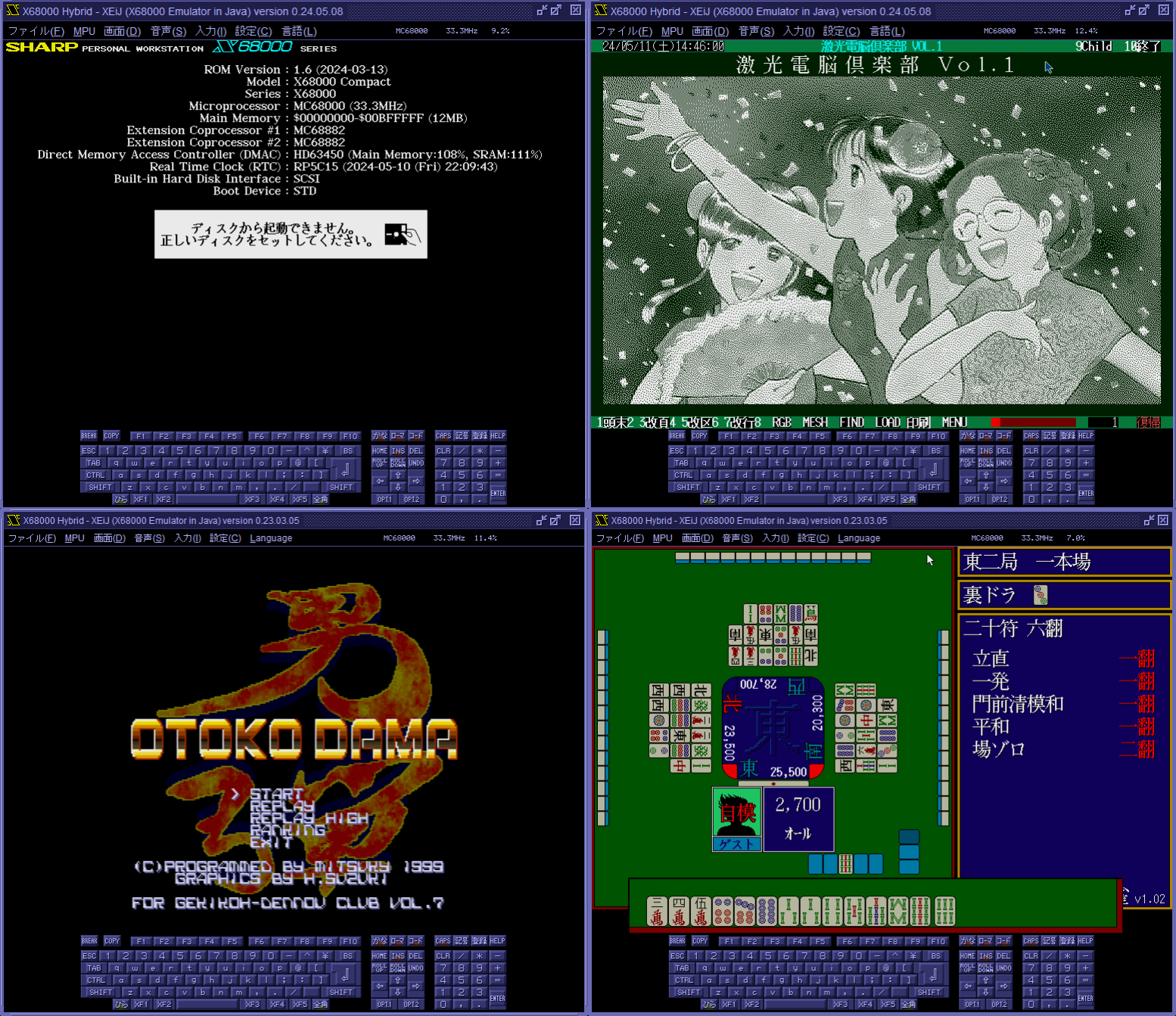
XEiJ (X68000 emulator in Java) est un émulateur de Sharp x68000 écrit en Java dont il vous faudra ce runtime pour l’exécuter.


Télécharger XEiJ v0.26.07.08 (74.7 Mo)

Site Officiel

En savoir plus…

Il s’agit du seul émulateur Basic Master disponible (très bon, au demeurant !), connu également sous le nom de Bml3mk5. Cliquez sur « En savoir plus » pour la description résumée de ce système.
Des versions avec debuggeur sont disponibles sur le site officiel.
 
mark5
 

Télécharger Hitachi Basic Master Level3 MARK5 (SDL) v2.1.4 (2.3 Mo)

Télécharger Hitachi Basic Master Level3 MARK5 (x86) v2.1.4 (479 Ko)

Télécharger Hitachi Basic Master Level3 MARK5 (x64) v2.1.4 (520 Ko)

Site Officiel

En savoir plus…

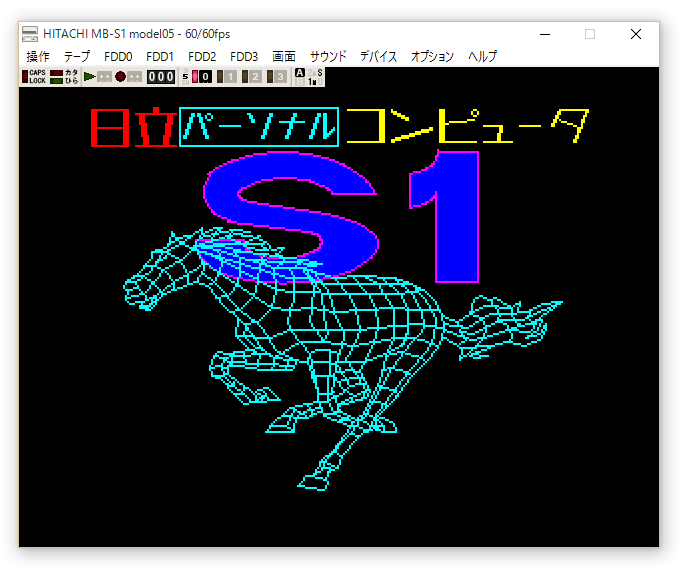
Un émulateur d’Hitachi MB-S1 Model05 créé par Sasaji.


Télécharger Hitachi MB-S1 Model05 (x86) v0.9.4 (602 Ko)

Télécharger Hitachi MB-S1 Model05 (x64) v0.9.4 (668 Ko)

Site Officiel

En savoir plus…

Il s’agit d’un émulateur de MS-DOS en ligne de commande destiné à Windows x86-64 (mais également aux versions 32 bits). Version dédiée à l’émulation des processeurs i286/i386/i486.


Télécharger MSDos Player for Win32-x64 (2026/07/31) (2.1 Mo)

Site Officiel

En savoir plus…

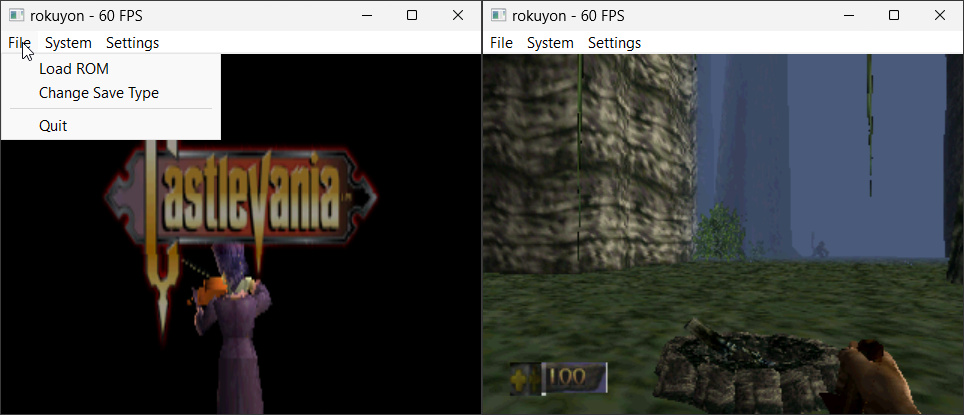
Il s’agit d’un émulateur de Nintendo 64 expérimental.


L’objectif principal avec Rokuyon est d’en savoir plus sur le matériel de la Nintendo 64 afin de pouvoir écrire des homebrews comme sodium64. Et si cela finit par être plus que cela… Il se peut à ce moment là que l’auteur soit intéressé pour créer un émulateur N64 moderne et précis avec un rendu logiciel / matériel intégré et sans aucun plug-in désordonné. A suivre donc…
 

Télécharger Rokuyon R260614 (3.3 Mo)

Site Officiel

En savoir plus…

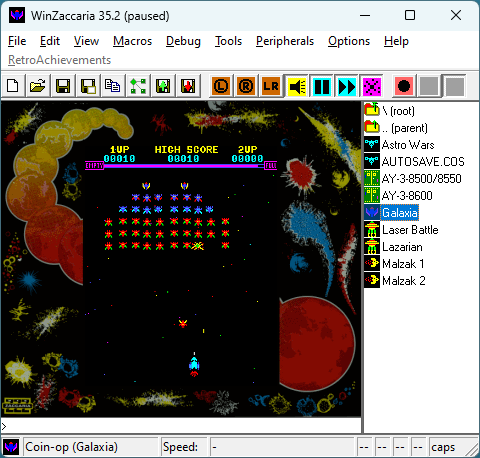
AmiArcadia est le port amélioré de Tunix2001 ex ‘Win Arcadia 2001’ (par Gavin Turner) pour Amiga. Ecrit par James Jacobs et Gavin Turner, cette version est en fait le port Windows du port Amiga (un backport) !


Systèmes émulés:
 
Consoles:
– Famille Emerson Arcadia 2001 : Bandai, Emerson, Grandstand, Hanimex, Intervision, Leisure-Vision, Leonardo, MPT-03, Ormatu, Palladium, Poppy, Robdajet, Rowtron, Tele-Fever, Tempest, Tryom, Tunix, etc.
– Interton VC 4000 et compatibles : Acetronic, Cabel, Fountain, Hanimex, Interton, Prinztronic, Radofin, Rowtron, Voltmace, Waddingtons…
– Elektor TV Games Computer (1979)
 
Machines PIPBUG/BINBUG:
– Electronics Australia 77up2/78up5, Signetics Adaptable Board Computer, Eurocard 2650…
– Signetics Instructor 50 (1978)
– Signetics TWIN (1976)
– Central Data 2650 (1977)
– PHUNSY microcomputer (c.1980)
– Ravensburger Selbstbaucomputer / 2650 Minimal Computer (1984)
– Hofacker MIKIT 2650 (1978)
 
Machines d’arcade:
– Coin-ops Zaccaria : Astro Wars, Galaxia, Laser Battle, Lazarian
– Coin-ops Kitronix : Malzak 1 & 2
 
Jeux électroniques:
– Consoles Pong AY-3-8500/8550/8600:
– Coleco Telstar Galaxy, Sheen TVG-201, et autres systèmes AY‑3‑85xx
 
Machine éducative électronique:
– VTech Type-Right (1985)
 

Il nécessite Windows 9x/ME/NT/2000/XP et fonctionne également sous Vista/8/10/11.


Télécharger Win Arcadia (Ami Arcadia) v36.55 (8.8 Mo)

Site Officiel

Un gestionnaire de roms avec une interface aussi claire que Romcenter et axé sur la simplicité avec un nombre limité de fonctions. Une référence désormais.
 
L’immense avantage de ce manager est de pouvoir scanner n’importe quel repertoire de roms , en VRAC & ensuite -en fonction de ce que vous avez comme dats- de les ranger et replacer automatiquement. (très utile si vous avez des tonnes de dats (TOSEC). Il vous permet réellement de collectionner des centaines de collections avec un gain de temps considérable par rapport aux autres managers. Il convertit également les zips au format Torrentzip afin de faciliter le partage à travers les fichiers torrent.
 
romvault2.1
 
Les changements sont visibles ici.
 

Télécharger RomVault v3.8.0 (1.7 Mo)

Site Officiel

En savoir plus…

Amiberry est un émulateur Amiga optimisé, libre (GPLv3), basé sur le cœur WinUAE, conçu pour ARM et x86 (Raspberry Pi, PC, etc.), offrant JIT ARM64/x86-64, interface moderne (Dear ImGui), support WHDLoad, shaders/bezels, intégration RetroArch et une distribution multi‑plateforme (Linux, macOS, Windows, Android, FreeBSD, Haiku) avec paquets et scripts d’installation prêts à l’emploi.


Télécharger Amiberry v8.3.0 (27.6 Mo)

Site Officiel

En savoir plus…

Sorte d’équivalent de MAME32 pour PinMAME. Cette version est un vrai portage de PinMAMEW sous Windows.
 
PinMAME émule le matériel présent dans presque toutes les machines à flipper à semi-conducteurs créées depuis les premiers jours des machines contrôlées par CPU (milieu des années 1970) jusqu’en 2014 (Stern SAM), avec environ 770 machines à flipper uniques émulation et bien plus de clones/révisions (au total plus de 2700 ensembles). Il est disponible sous différentes formes :
 
– Émulateur autonome (PinMAME (ligne de commande), PinMAME32 (UI))
– Bibliothèque COM (VPinMAME) pour piloter des simulateurs comme Visual Pinball 8/9/X
– Bibliothèque (libPinMAME) pour piloter des simulateurs comme VPE, VPX Standalone, ou des solutions de remplacement matériel comme PPUC


Télécharger Visual PinMAME v3.7 build 372 (141 Mo)

Site Officiel

En savoir plus…

Il s’agit d’un émulateur d’Apple II+ et //e, écrit en Go.


Télécharger izapple2 v2.4 (4.9 Mo)

Site Officiel

En savoir plus…

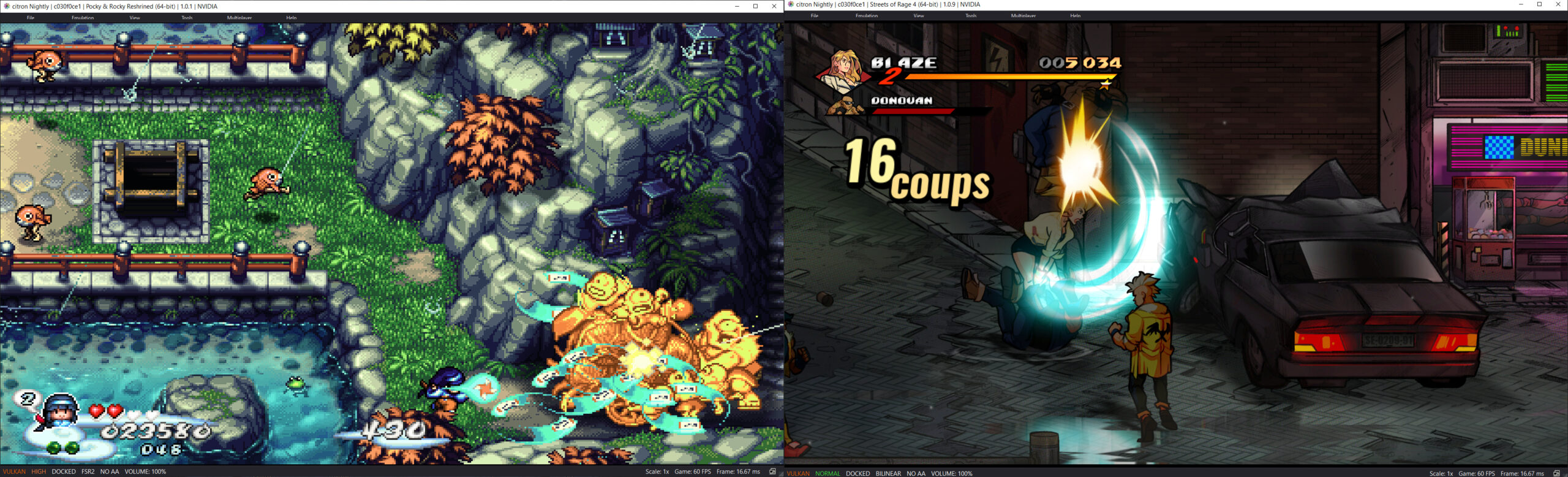
Il s’agit d’un fork de l’émulateur Switch Citron, repris exactement à l’endroit où son développement s’était arrêté.


Les changements:
– Merge pull request #298 from cheezwiz7899/dynarmic-update2
– update dynarmic pin to 7bec834bcadbb8b7def7c552a08ad4ac189d4397
– xbyak_abi: gate custom containers behind a compile definition


Télécharger Citron Neo (2026/08/05) (60.0 Mo)

Site Officiel

En savoir plus…


Casino-en-ligne-fiable.com

https://getourbonus.com/fr/accueil

https://www.romspedia.com/

https://www.casinoonlinefrancais.fr

Lucky 7 bonus

https://www.casinogratuitsansdepot.com

pablocasino.org

critiquejeu.info

playbonus

casinodoc.org

laplanquedujoueur.com

casinoonlinefrancais