

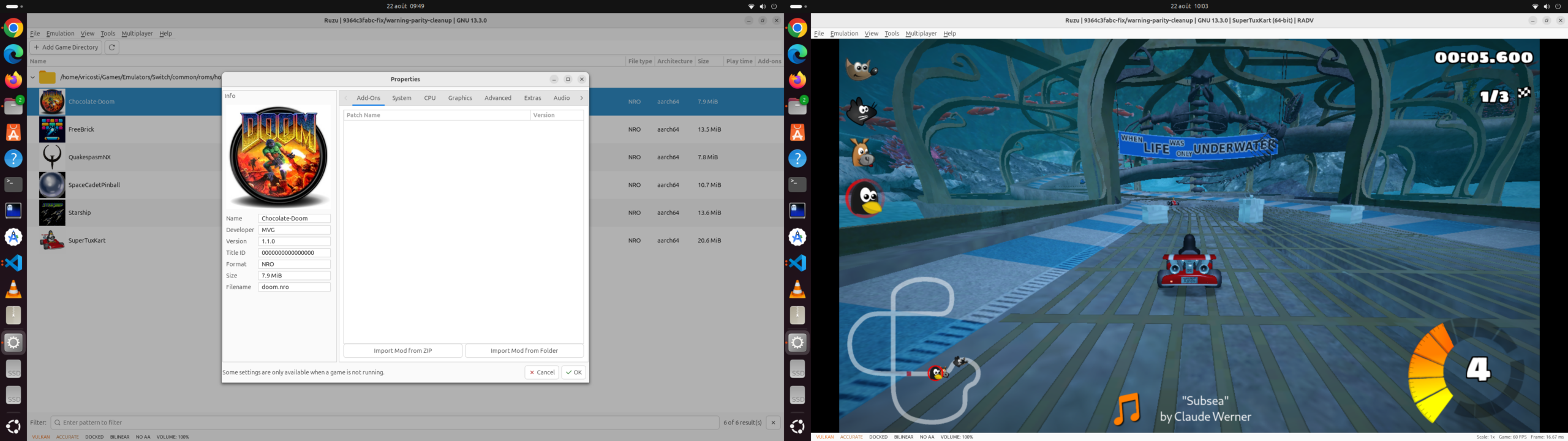
Ruzu est un émulateur Nintendo Switch écrit en Rust, développé comme une expérience visant à déterminer si l’IA, via des modèles de langage (LLM), pouvait réaliser le portage complet d’un projet logiciel de très grande taille de C++ vers Rust.
Le projet est basé sur le code de yuzu/Eden et représente environ 500 000 lignes de code portées exclusivement avec l’aide de LLM, sur une période d’environ six mois. L’objectif n’était pas simplement d’obtenir un programme fonctionnel, mais de conserver au maximum la structure du projet original, avec une correspondance entre les fichiers et les différentes parties du code C++ et Rust.
Ruzu intègre notamment un kernel HLE avec ordonnanceur, fibres, IPC et services, un processeur de commandes GPU, un recompilateur de shaders et un JIT. La recompilation dynamique du code ARM est assurée par rdynarmic, un portage Rust de Dynarmic, avec des backends natifs x86-64 et ARM64. Le projet comprend également rxbyak, un portage Rust de Xbyak pour la génération de code machine x86-64.
L’émulateur est déjà capable de démarrer et d’exécuter des jeux commerciaux, avec l’objectif affiché d’atteindre les performances de l’implémentation C++ originale. Le projet reste toutefois en développement.
Ruzu dispose également d’un frontend graphique ainsi que d’un frontend en ligne de commande, et peut être compilé sous Windows, Linux, macOS et plusieurs systèmes BSD.
Les changements sont:
– Extracted games: Ruzu can open an extracted exefs/main and find the matching RomFS without opening every file in the game directory at startup.
– Graphics stability: fixed a freeze that could occur when one GPU channel reused a buffer another channel had already released. Native compute shaders now use the correct local-memory addresses, fixing a GPU fault observed on AMD hardware.
– Video and applets: improved AV1 intro playback and fixed software keyboard requests that were rejected when a title used an extended applet ID.
– Experimental Switch 2 title support: per-session hardware profiles with automatic memory sizing, native title loading, the mesh and task shader draw path, and the display path used by these titles.
– Stopping a game: fixed several freezes on « Closing software… » and shortened shutdown when a large shader was still compiling.
– GPU ASTC recompression (experimental, Vulkan): a new option in Graphics > Extras decodes ASTC textures and encodes them to BC3 on the GPU instead of the CPU. On the tested system it shortened the first minute of loading by several seconds and reduced stutter. Off by default.
-Texture handling: BC7 as a recompression target and a disk cache for converted textures.
– Metal (macOS): Switch 2 task and mesh draws, and fixes for compute storage buffers.
– Interface: the Graphics > Extras page is translated in all interface languages.
– Release tooling: release candidates now carry their version in the window title.