
Quickplay est un grand frontend multi-système incluant des fonctions avancées pour Mame, Virtual Tree, Emu-Finder, un système IPS, Mirroring de répertoire, support Zip pour les émulateurs ne le supportant pas et beaucoup d’autres choses.
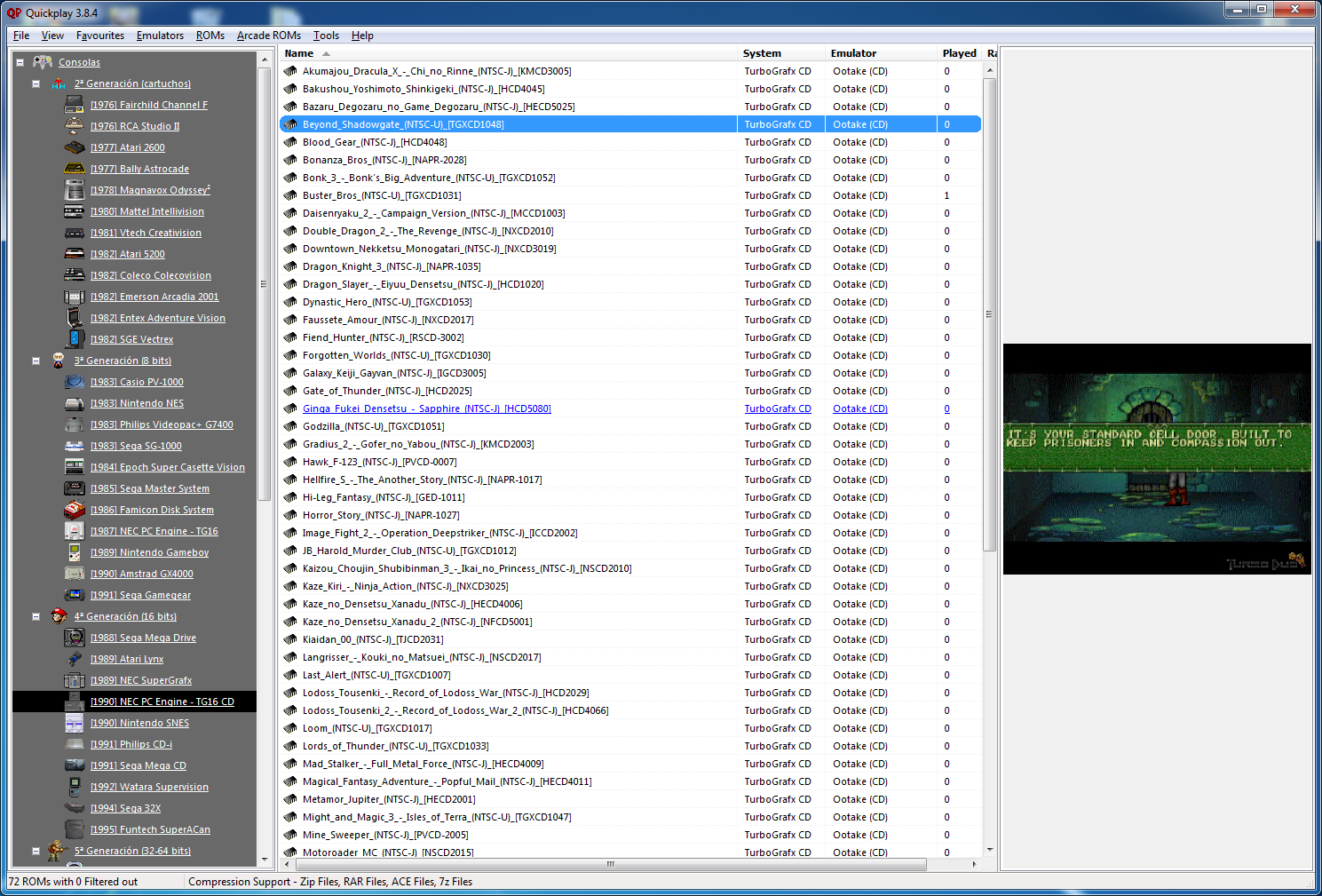


New Features
Synctool
– You can setup a single Remote and local folder – anything under will sync: clicking on a rom will cause it to cache locally if necessary
– Directories are mirrored as well as files cached, so folder structure form source is maintained (you know what roms are from what system)
– Symlink support so that you can extend your storage/keep CD/DVD files in a different location
– Synctool Options – Electron UI Element which manages and talks to the new qpnode settings file
– Romdata Flip – Users can change the Local path to the Remote one and vice versa in multiple Romdatas
– UI component to Romdata Flip shows you files changed, also prompts confirmation
– Remove syncing abilities of QuickPlay Multiloader, now vastly superceeded
– Update Johnlib with various types of exe running code that have varying effects (like printing to console)
– QuickPlay calls to node to see if Synctool is Enabled before doing anything
– Waits a while after running so you can see what happened, also writes to logfile in QuickPlay’s root
– Quit with ctrl+c implemented (you sometimes have to wait for the current chunk to finish)
– Copies timestamps as well as files, uses timestamps to determine equality
– Timestamp difference tolerance (configurable). I don’t know why sometimes timestamps are off with copies of files not done through synctool, but they are
– Timeout for finding roots (try not to hang loading a potential rom just because we can’t check if its the same file as on the server)
– Some investigation of a stream-based solution, left as an option but just too slow
 
Mametool Paths
– Disabled by default, Mametool can work out paths of all files from mame.xml and print them in Romdatas
– Implemented for both Arcade and Mess Softlists (much more useful for the latter)
– We can only sync one file, but print helpful info to the log about other files which need to exist locally in order for games to run (eg: BIOS)
– Mame Options enlarged and added to
– you can select what kind of merged roms you have (it affects what the filenames would be)
– Looks up your mame.ini (or mess.ini) for your MAME Rompaths, uses conventional names to distinguish (or you can have all roms in one ROMS folder)
– Defaults to old behaviour in case of issues (printing a ‘sentinel’ filepath in a romdata entry so QuickPlay ignores the filepath element)
 
Node/Electron
– First use of Nodejs Electron in QuickPlay to run synctool options (the hope is to extend this somewhat)
– build and binary process implemented, Delphi makes appropriate exe calls
– resolved some issues with old js packaging process, hopefully to be superceeded by the new process
– json options file implemented, creation process implemented (its a plan to avoid upgrading issues with overwriting settings)
 
Bugfixes
– Right-click explorer explores to file not just dir (thanks to user ‘quickplayer’)
– Quotes in mednafen in case of no 8:3 (also thanks to ‘quickplayer’)
– fixed bug with mame0.211 softlist printing (thanks to u-neeks for a fantastic bug report!)


Télécharger QuickPlay v4.7.6 (112 Mo)

Site Officiel

En savoir plus…

Hoxs64 est un émulateur Commodore 64 tournant sous Windows avec DirectX 9 au minimum. Il est encore en développement, si bien que s’il manque quelques choses maintenant, elle sera là plus tard (dixit l’auteur) 😉
 
hoxs1

hoxs2
 

1) Fix joystick settings dialog configuration fault.


Télécharger Hoxs64 (x86) v1.1.2.9 (4.4 Mo)

Télécharger Hoxs64 (x64) v1.1.2.9 (5.1 Mo)

Télécharger Hoxs64 (9X/2K) v1.0.23 (503 Ko)

Télécharger Hoxs64 Français (9X/2K) v1.0.23 (542 Ko)

Télécharger Hoxs64 Français (x86) v1.1.2.9 (3.7 Mo)

Télécharger Hoxs64 Français (x64) v1.1.2.9 (3.7 Mo)

Site Officiel

En savoir plus…

Créé par Exzap, il s’agit du second émulateur de Wii U à être disponible au public mais le premier à pousser jusqu’à l’émulation de jeux commerciaux. Il peut décrypter les images Wii U qui utilisent le format Wud mais également les fichiers RPS ou RPL. La résolution interne peu aller jusqu’à 1920×1080 selon les jeux. A noter que pour le moment, un seul contrôleur est accepté, il s’agit du DRC (GamePad) de la Nintendo Wii U. Cette version n’est compatible que pour les Windows x64 (à partir de Windows 7) avec une carte graphique gérant OpenGL 4.1 ou supérieur et il faudra posséder 4 à 8 Go de mémoire vive (Ram) pour le faire fonctionner. (Correspondance ID-Titre).
 
Un tuto est disponible ici.
 

cemu
 
Les changements:
 

En résumé:
– Bug fixes
– Small usability improvements

 
En détails:
# New in 1.15.16c:
general: Fixed error message when booting any game
 
# New in 1.15.16b:
general: Fixed a bug where previously created controller profiles would not show up in input settings
 
# New in 1.15.16:
general: Tab and Ctrl+Tab for swapping TV/GamePad screen now only works if Cemu is in focus
general: Fixed an issue where Cemu would freeze on shut down (#175)
general: Improved robustness of Cemu auto-updater
general: Fixed launching games in fullscreen when UI fullscreen option is enabled
general: If a filter is set the graphic pack window will auto-unfold the top node and small subnodes

debugger: If a game ships with debug symbols they should show up in assembly view again

RPL: Retrieve name of update .rpx from cos.xml instead of using the name of the base rpx
Fixes Wii Sports Club update not launching

ErrEula: Fixed message boxes with long button text

Input: Improved performance when using Wiimotes

 
Note:
(#xx) refers to bug tracker issues resolved by this change. See http://bugs.cemu.info/projects/cemu/


A noter que des packs graphiques haute définition sont disponibles ici. Ils permettent, entre autre, d’augmenter la résolution native des jeux car contrairement à Dolphin et parce que la machine est techniquement différente il n’est pas possible à Cemu d’augmenter la définition autrement que par cette méthode.
A l’inverse, des packs SD (définitions standards et/ou basses) sont disponibles sur ce lien et permettent à certains PC manquant de performance de lancer des jeux en 60 FPS.

 
Une liste de compatibilité est disponible ici.

 
Site source.

Télécharger Cemu v2.6 (35.6 Mo)

Site Officiel

En savoir plus…

Un excellent manager de roms à l’instar de clrmame et Romcenter. Romulus est capable d’importer les dats de RomCenter et clrmame (ancien format et format xml), les fichiers offlinelist et Mess. Il gère les roms non compressées ou compressées en zip, rar ou 7z. Il supporte également le Torrentzip. Il peut également importer un dat à partir de l’exécutable de Mame, générer des rapports ou des statistiques…
 
Il dispose également d’un navigateur intégré, d’un localisateur de DATS, supporte les CHD de Mame…


Les changements:

– ADDED A lot of new code for Community module. Working hard to make this dream reality.
– CHANGED Romulus web host to https://romulusrommanager.000webhostapp.com/
– FIXED Popupmenu from Scanner-Profiles tabs.
– FIXED Rare rendering problem when updating status icons of Scanner-Profiles tabs.
– FIXED Notifications display in Windows 10.
– FIXED Center on screen forms by compiler bug.
– FIXED Visuals displaying forms.


romulus


Télécharger Romulus v0.049 (7.7 Mo)

Site Officiel

En savoir plus…

Il s’agit du seul émulateur Basic Master disponible (très bon, au demeurant !), connu également sous le nom de Bml3mk5. Cliquez sur « En savoir plus » pour la description résumée de ce système.
Des versions avec debuggeur sont disponibles sur le site officiel.
 

mark5


Télécharger Hitachi Basic Master Level3 MARK5 (x86) v2.1.4 (479 Ko)

Télécharger Hitachi Basic Master Level3 MARK5 (SDL) v2.1.4 (2.3 Mo)

Télécharger Hitachi Basic Master Level3 MARK5 (x64) v2.1.4 (520 Ko)

Site Officiel

En savoir plus…

Stella est un excellent émulateur Atari VCS 2600 multi-platformes, releasé sous licence GPL. A la base, le projet a été développé pour Linux par Bradford W. Mott, cependant de nombreuses personnes ont rejoint l’équipe de développement pour porter Stella sur différents systèmes d’exploitation tels qu’AcornOS, AmigaOS, DOS, FreeBSD, IRIX, Linux, GP2X, OS/2, MacOS, Unix, et Windows (ouf!).
Cette version inclut les binaires 32 et 64 bits.


stella
 
Les changements sont:
 

    Updated properties database for Pink Panther ROM.


Télécharger Stella (64 bits) v7.0c (4.1 Mo)

Site Officiel

En savoir plus…

Mesa3D peut être utilisé pour fournir un moteur de rendu Software aux applications OpenGL et est particulièrement utile pour exécuter d’anciennes applications et jeux qui utilisent une ancienne version d’OpenGL et qui ne fonctionnent pas correctement sur du matériel moderne.
Notez que ce dispositif de rendu est loin d’être parfait, et de nombreux jeux ne fonctionneront pas encore.
 
Des instructions sur l’utilisation de la DLL sont incluses.


NB: Parce que certaines applications et jeux vont refuser de charger opengl32.dll à partir de leur répertoire, vous pouvez utiliser MesaInjector.
 

Télécharger Mesa3D (x86) v20.1.8 (6.7 Mo)

Télécharger Mesa3D (x64) v20.1.8 (8.4 Mo)

Télécharger MesaInjector v20.1.8 (8.5 Mo)

Site Officiel

En savoir plus…

Il s’agit d’une interface graphique écrite par Tyler J. Stachecki et destinée à l’émulateur de Nintendo64 nommé CEN64.


cen64qt
 
– Fix bug with grid view background and newer versions of Qt
– New Russian translation
– Removed support for Qt4
– Fixes

 
Forum officiel.
 

Télécharger Cen64 QT (Frontend) Alpha (2024/11/10) (13.7 Mo)

Site Officiel

En savoir plus…

Il s’agit d’une interface graphique pour l’émulateur de Nintendo 64 nommé Mupen64Plus, par l’auteur de Cen64 QT.


mupen


– Fix bug with grid view background and newer versions of Qt
– New Russian translation
– New SDL key codes reference in the config editor
– Added documentation links in the application
– New dialog for reference to Mupen64plus’ default controls
– Removed support for Qt4

 
Forum officiel.
 

Télécharger Mupen64Plus QT (Frontend) v1.17 (2024/11/18) (15.9 Mo)

Site Officiel

En savoir plus…

Un émulateur de Commodore C65 qui fut un prototype et qui ne fut jamais vendu officiellement par Commodore.


C65

 
Il reste du travail car il manque un fichier pour fabriquer un programme en basic. L’emulateur n’est pas tout à fait opérationnel à ce niveau ; il faut d’abord prendre le fichier manquant COMDLG32.OCX qu’il faut installer dans win32 ou wow64 puis écrire le programme Basic dans le pad de windows et le ‘tokenized’ (transormer le texte en programme).

 
– Changed the types of the program counter, data counter and expression counter from unsigned integer to unsigned long to allow for longer programs.
– Modified the keyboard handling functions so that they yield CPU time every time they are called
– Fixed a bug in the INPUT# function that used to leave the file open after the program terminates for attempting to read past EOF.
– Added a check in the LET function that stops the execution of a program if a string is over 255 characters long.
– Implemented string chaining with the operator + , with an arbitrary number of strings (up to the limit of 255 characters).
– Fixed a bug in the PRINT function that prevented the cursor from going to the next line when a single instruction displays more characters than a line can fit.
– Implemented the LEN instruction, to know the length of a string or chain of strings.
– Implemented the RESTORE instruction, to move the data counter to the desired line or to the beginning of the data section.
– Added checks in both the frontend and the main executable to force the emulator to run in full screen when launched from the frontend, to avoid an « invalid video mode » error.
– Added a check that recognizes attempts to execute an empty program file and skips them.


Télécharger Hi65 v9.1 (1.7 Mo)

Site Officiel

En savoir plus…


CPCEC est un émulateur d’Amstrad CPC (modèles 464, 664 et 6128). ZXSEC est un émulateur de Sinclair ZX Spectrum (modèles 48k, 128k, +2/Plus2 et +3/Plus3) pour Windows.
 

Télécharger CPCEC / ZXSEC / CSFEC / MSXEC (2026/01/31) (1.2 Mo)

Site Officiel

En savoir plus…

bsnes-plus (ou bsnes+) est un fork de bsnes (basé sur bsnes-classic) destiné à introduire de nouvelles fonctionnalités et améliorations, la plupart visant au débogage. Il s’agit donc d’une version améliorée de bsnes 073 ou l’on retrouve donc l’ancienne interface ainsi que les anciens menus. Plus d’informations ici.
 
Il s’agit d’une version WIP (en cours de développement) dite « instable » basée sur les dernières sources GIT du projet.


Changements:
– snesfilter: experimental hires input support
– don’t display 17-bit VRAM addresses in PPU debuggers if expansion is supported but disabled
– invert VRAM bank selection pin(s) like the actual hardware mod does
– allow overriding default exe output name
– add performance profile to appveyor builds
– get rid of performance PPU and use compatibility PPU for both compatibility and performance profiles; they both perform basically the same and it wasn’t really worth the burden of maintaining both
– some fixes

 
Cette version est compatible avec le pack de shaders disponible ici.
 

Télécharger bsnes-plus (x86) WIP v05.60 (2020/05/09) (7.6 Mo)

Télécharger bsnes-plus (x64) WIP v05.105 (2025/03/23) (12.5 Mo)

Site Officiel

En savoir plus…


https://getourbonus.com/fr/accueil

https://www.romspedia.com/