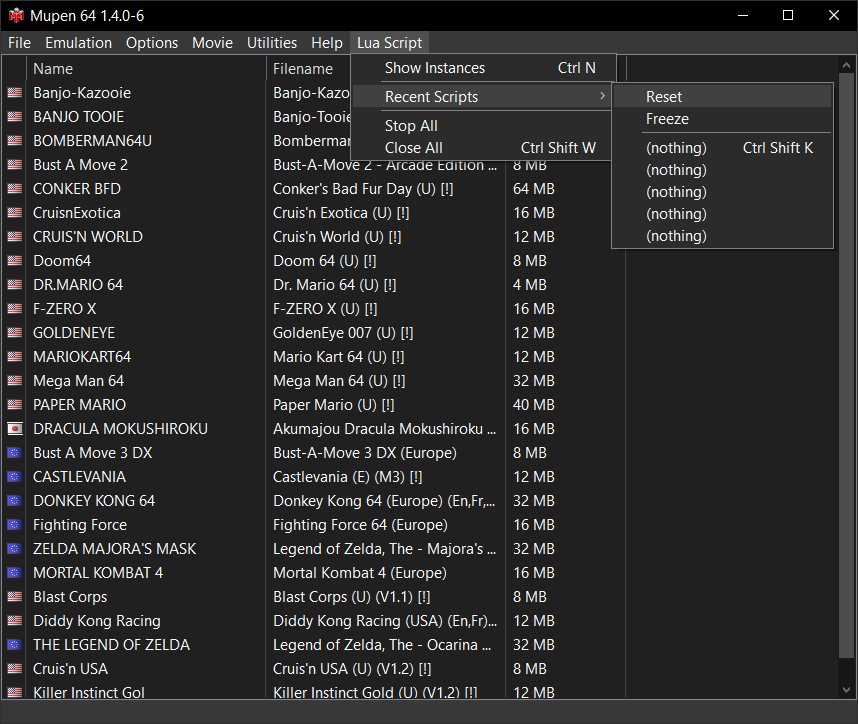
Mupen64 RR Lua (ou Mupen64 Re-recording Lua) est un fork (le 3eme) de Mupen64 permettant l’enregistrement de vidéo.


Les changements sont:
 
🐞 Bugfixes
– Core: Crash when compiling cheats with empty lines (#853)
– Race condition during plugin initialization (#850)
– Plugin version not fitting in spec-defined bounds (#847)
– Core: Ultra fast-forward engaging in unintended cases (#841)
– Seek during capture mangling output (#839)
– FFmpegEncode: Space in output path causing capture failure (#946)

 
Site original. Fork 1. Fork 2. Fork 3.
 

Télécharger Mupen64 RR Lua v1.4.8 (+AVI Fixes builds) (11.0 Mo)

En savoir plus…

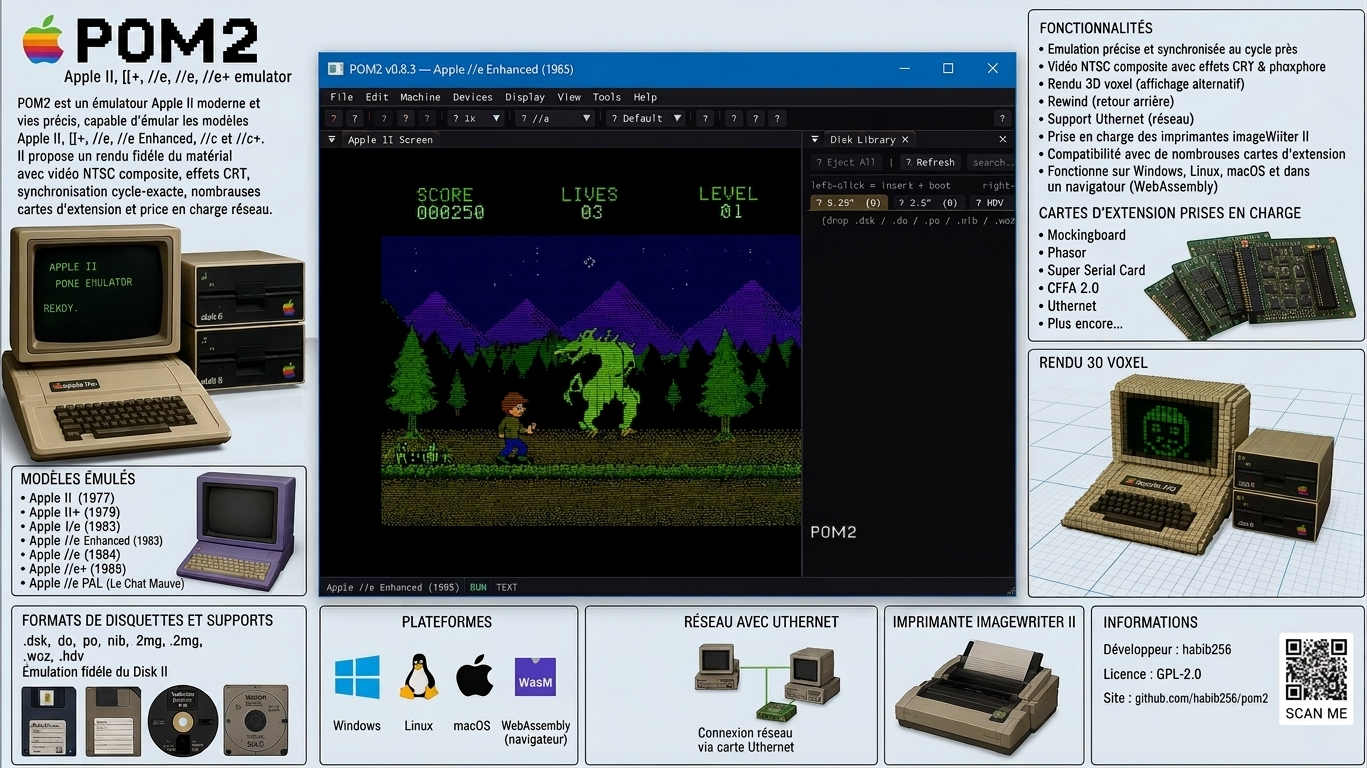
POM2 est un émulateur Apple II moderne et open source, capable d’émuler plusieurs machines de la famille Apple II, de l’Apple ][ original de 1977 jusqu’à l’Apple //c+ de 1988. Il vise une émulation très précise du matériel, avec un rendu vidéo synchronisé au niveau du cycle CPU.


Il prend notamment en charge l’Apple ][, ][+, //e, //e Enhanced, //c et //c+, ainsi que deux variantes PAL, dont le //c « Le Chat Mauve ».
 
Parmi ses particularités, POM2 propose un rendu NTSC composite, des effets CRT/phosphore, une vue 3D en voxels, le rewind, l’émulation de nombreuses cartes d’extension comme les Mockingboard, Phasor, Super Serial Card, CFFA 2.0 et Uthernet, ainsi que la prise en charge des imprimantes ImageWriter II.
 
L’émulateur gère de nombreux formats de disquettes et supports Apple II (.dsk, .do, .po, .nib, .2mg, .2img, .woz, .hdv) et intègre une émulation fidèle du Disk II. Il dispose également d’un support réseau via Uthernet et peut même fonctionner directement dans un navigateur grâce à WebAssembly.


Télécharger POM2 v0.8.3 (4.2 Mo)

Site Officiel

En savoir plus…

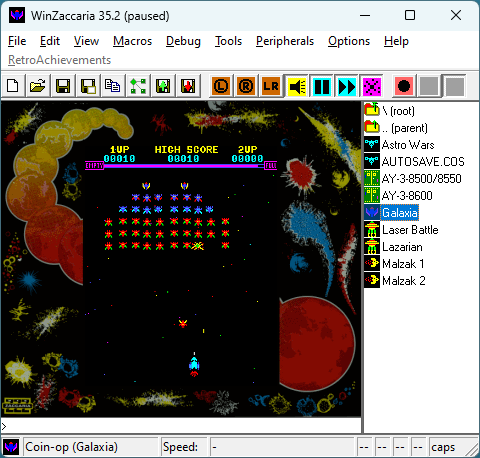
AmiArcadia est le port amélioré de Tunix2001 ex ‘Win Arcadia 2001’ (par Gavin Turner) pour Amiga. Ecrit par James Jacobs et Gavin Turner, cette version est en fait le port Windows du port Amiga (un backport) !


Systèmes émulés:
 
Consoles:
– Famille Emerson Arcadia 2001 : Bandai, Emerson, Grandstand, Hanimex, Intervision, Leisure-Vision, Leonardo, MPT-03, Ormatu, Palladium, Poppy, Robdajet, Rowtron, Tele-Fever, Tempest, Tryom, Tunix, etc.
– Interton VC 4000 et compatibles : Acetronic, Cabel, Fountain, Hanimex, Interton, Prinztronic, Radofin, Rowtron, Voltmace, Waddingtons…
– Elektor TV Games Computer (1979)
 
Machines PIPBUG/BINBUG:
– Electronics Australia 77up2/78up5, Signetics Adaptable Board Computer, Eurocard 2650…
– Signetics Instructor 50 (1978)
– Signetics TWIN (1976)
– Central Data 2650 (1977)
– PHUNSY microcomputer (c.1980)
– Ravensburger Selbstbaucomputer / 2650 Minimal Computer (1984)
– Hofacker MIKIT 2650 (1978)
 
Machines d’arcade:
– Coin-ops Zaccaria : Astro Wars, Galaxia, Laser Battle, Lazarian
– Coin-ops Kitronix : Malzak 1 & 2
 
Jeux électroniques:
– Consoles Pong AY-3-8500/8550/8600:
– Coleco Telstar Galaxy, Sheen TVG-201, et autres systèmes AY‑3‑85xx
 
Machine éducative électronique:
– VTech Type-Right (1985)
 

Il nécessite Windows 9x/ME/NT/2000/XP et fonctionne également sous Vista/8/10/11.


Télécharger Win Arcadia (Ami Arcadia) v36.61 (8.7 Mo)

Site Officiel

Il s’agit d’un émulateur de N64 écrit en Rust par Logan McNaughton (simple64) et dont certaines portions proviennent de mupen64plus et/ou ares.


Les objectifs en résumé sont les suivants:
– Performance. L’auteur veux pouvoir utiliser cet émulateur sur son ordinateur portable.
– Facile à utiliser.
– Facile de travailler avec. Les recompilateurs dynamiques sont performants mais ils sont très difficiles à lire et à comprendre. Cet émulateur n’aura des interprèteurs que pour le CPU et RSP. De plus, il est entièrement écrit en Rust (en dehors de Parallel-RDP), un langage de programmation moderne dont le nombre d’utilisateurs ne cesse de croître. L’auteur a essayé d’éviter l’utilisation de macros, qui peuvent réduire la répétitivité du code, mais aussi sa lisibilité.
 

Les changements sont:
 
– Add GPU hints on Windows to help select dedicated GPU
– Update Rust/SDL
– Update netplay auth code
– Update RetroAchievments library
– Fix rumble on some controllers
– Fix VRU bug
– Fix crash in some libdragon ROMs


Télécharger Gopher64 v1.1.36 (61.7 Mo)

Site Officiel

En savoir plus…

Un émulateur du système Symbian OS. (Builds automatiques)


– Merge pull request #631 from yeatse/upstream/kernel
– kernel: object lifetimes, timers, image loading and the executive tables
– Merge pull request #627 from yeatse/upstream/case-sensitive-host
– common, system: resolve host paths on a case-sensitive filesystem
– Merge pull request #630 from yeatse/upstream/drop-pycache
– patch: drop a committed Python bytecode cache
– Merge pull request #629 from yeatse/upstream/dispatch
– dispatch: guest notifications, wrong values and missing entry points
– Merge pull request #628 from yeatse/upstream/vfs-file-handle
– vfs, common: never hand a null host FILE to the C library
– Merge pull request #626 from yeatse/upstream/common-helpers
– common: fix five defects in the shared helpers, and one data race
– Merge pull request #609 from yeatse/ci/sanitiser-job
– ci: Run the unit tests under ASan and UBSan, and fix what that found
– Merge pull request #610 from yeatse/feat/timezone-server
– services: Serve !TzServer from the emulator on Symbian^3 and up
– Merge pull request #624 from yeatse/fix/efsrv-path-state
– efsrv: Keep file sharing state under one form of the path
– Merge pull request #619 from yeatse/feat/accessory-mode
– accessory: Serve RAccessoryMode and the modern opcode set
– Merge pull request #622 from yeatse/feat/applist-recognize-data
– applist: Recognise data the way AppArc’s clients expect
– Merge pull request #621 from yeatse/fix/applist-duplicate-registry
– applist: Keep one registration per app, not one per scan
– Merge pull request #623 from yeatse/fix/sensor-callback-lifetime
– sensor: Make a backend callback safe to run
– Merge pull request #611 from yeatse/fix/service-object-lookup
– services: Look an object up by its id, not by where lower_bound lands
– Merge pull request #612 from yeatse/fix/ipc-null-descriptor
– services: Fail an IPC argument the client did not supply
– Merge pull request #613 from yeatse/fix/complete-unimplemented-ipc
– services: Complete a request nothing implements, do not drop it
– Merge pull request #614 from yeatse/feat/etel-clock-requests
– etel: Answer the network requests the Clock application makes
– Merge pull request #615 from yeatse/fix/alarm-id-lists
– alarm: Answer all three alarm id list requests
– Merge pull request #616 from yeatse/feat/featmgr-help-and-flash
– featmgr: Report the help application and the Flash Lite browser plug-in
– Merge pull request #617 from yeatse/feat/loader-physical-device
– loader: Answer Loader::LoadPhysicalDevice
– Merge pull request #618 from yeatse/feat/disk-space-thresholds
– services: Publish the critical disk-space thresholds at boot
– Merge pull request #620 from yeatse/fix/msv-epoc80-registry
– msv: Write the capability words from Symbian 8.0, not 8.1a
– Merge pull request #625 from yeatse/fix/efsrv-private-dir
– efsrv: Create a process’s own private directory on demand
– Merge pull request #608 from yeatse/fix/drop-stray-test-output
– tests: Drop a stray painter output committed by mistake
– Merge pull request #607 from yeatse/fix/package-uninstall
– package: Uninstall a package by what it actually installed
– Merge pull request #606 from yeatse/fix/graphics-fonts-screen-driver
– graphics, fonts: a batch of window-server, FBS and screen-driver fixes


Les infos sur cette version sont ici.
 

Télécharger EKA2L1 v0.0.9 r260821 (59.7 Mo)

Site Officiel

En savoir plus…

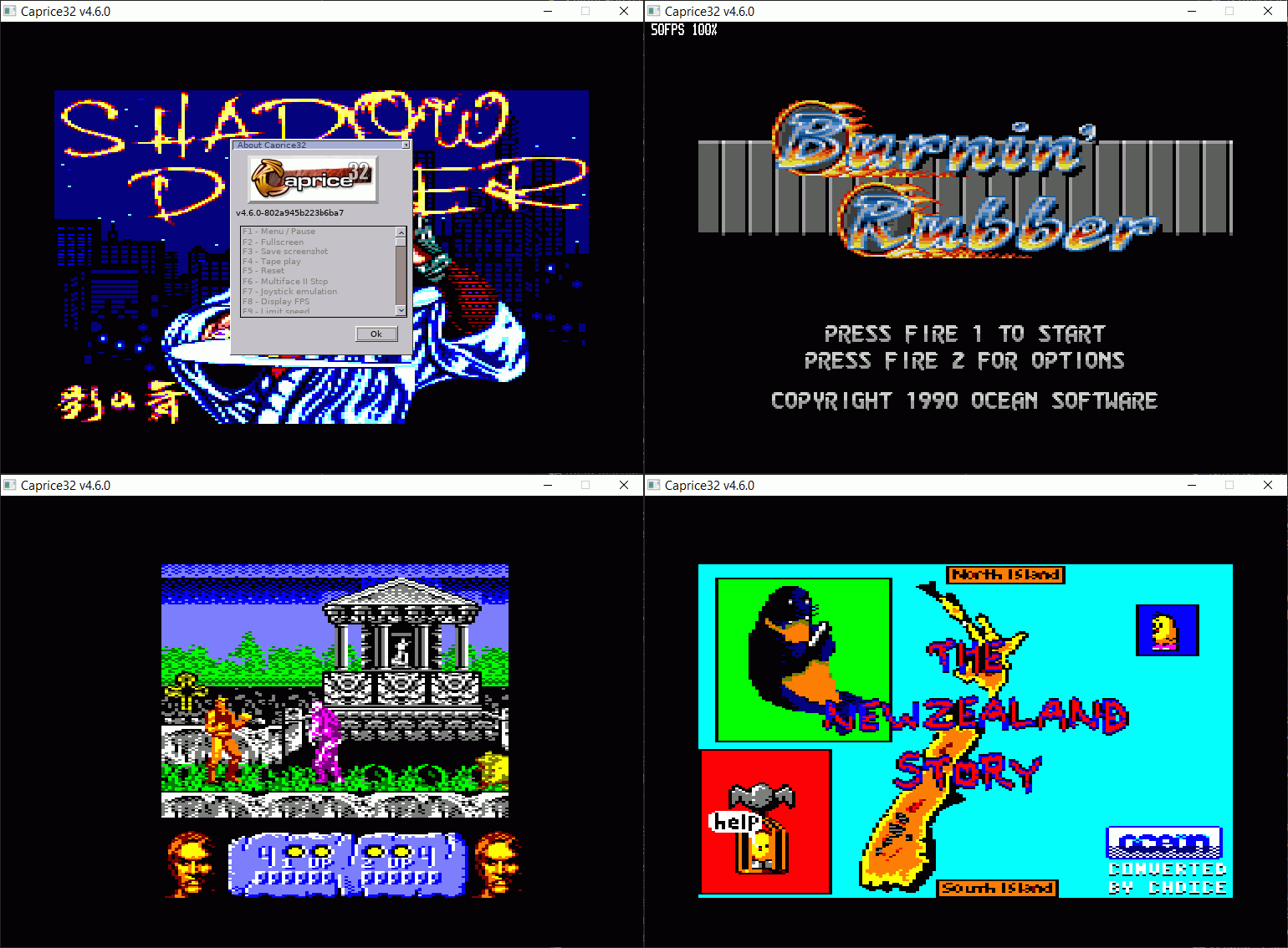
Cette version fait directement suite aux précédentes créées par Ulrich Doewich et est à présent maintenue par Colin Pitrat.


Latest build of Caprice 32, with the newest cool features and the most recent bugs.
 

Télécharger Caprice32 (x86) v4.6.0 (2026/08/21) (6.6 Mo)

Télécharger Caprice32 (x64) v4.6.0 (2026/08/21) (6.3 Mo)

Site Officiel

En savoir plus…

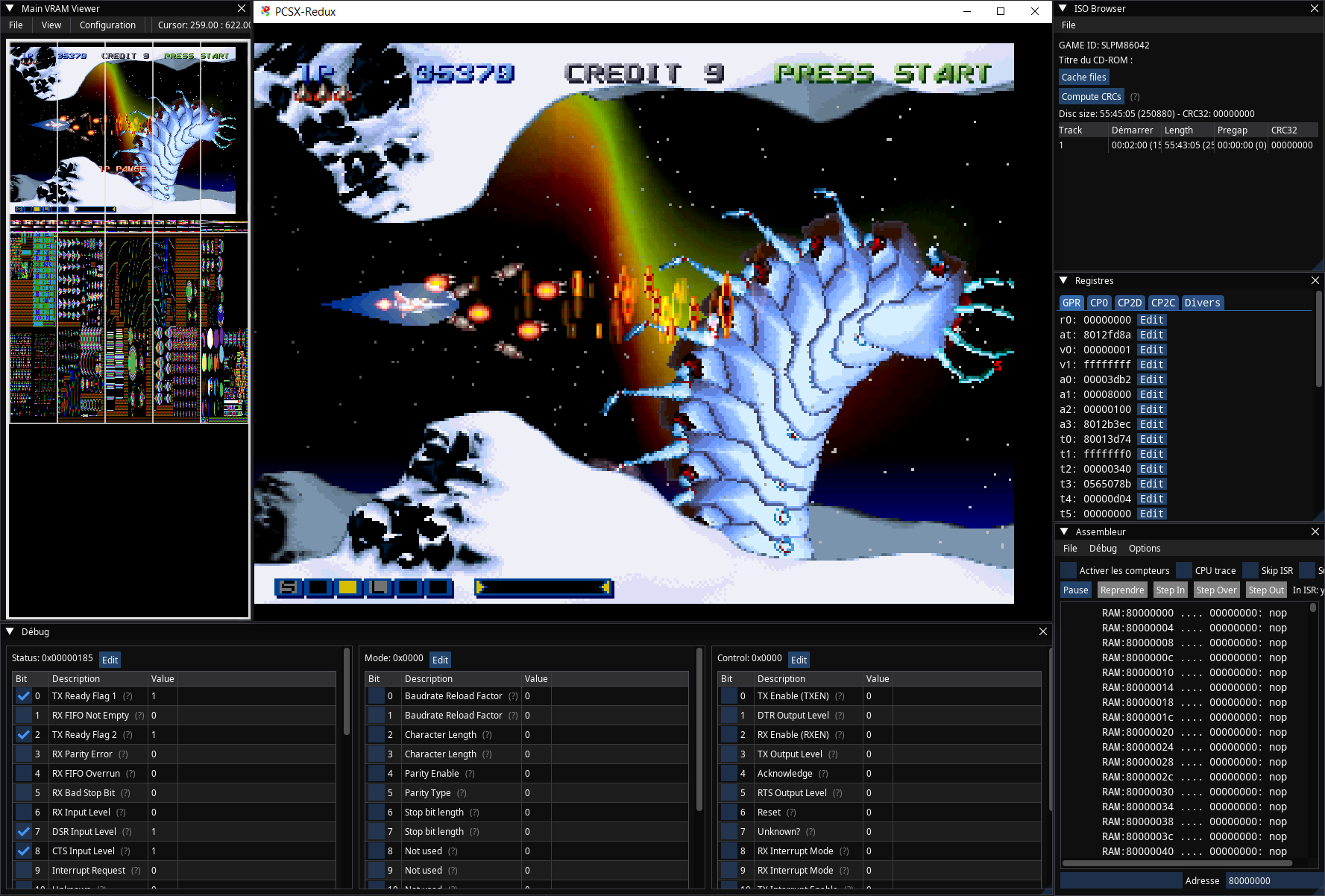
Ceci est un fork de l’émulateur Playstation, PCSX. L’objectif est à peu près le suivant:
 
– Apportez une base de code conforme aux normes d’aujourd’hui.
– En finir avec le système de plug-in et permettre une base de code monolithique unique qui gère tous les aspects de l’émulation Playstation.
– Utiliser SDL / OpenGL3 + / ImGui pour la portabilité et la lisibilité.
– Améliorez l’expérience du déboggage.
– Améliorez l’expérience de rendu.
 

Il s’agit de binaires préliminaires (anciennement ici).


NB: Je précise que ce sont des builds basés sur le GIT à un instant T, l’auteur n’a rien proposé de stable ni de finalisé. Ces versions sont toujours à considérer comme des versions alpha préliminaires tant que l’auteur ne propose officiellement rien d’autres, cela permet en outre de faire connaitre le projet au plus grand nombre et si certain(e)s d’entre vous veulent y contribuer, tant mieux pour tous. Donc il se peut que ce genre de build fonctionne ou pas du tout, c’est en soit « normal » car c’est tout sauf finalisé. Cela s’applique à tous builds dit « GIT » que nous proposons.
 

Télécharger PCSX Redux (32 bits) (2023/03/27) (41.0 Mo)

Télécharger PCSX Redux (64 bits) (2026/08/21) (42.8 Mo)

Site Officiel

En savoir plus…

Il s’agit d’un fichier permettant à MAME/MAMEUI de connaître la procédure à suivre pour l’initialisation d’un jeu.
 
Il contient des procédures générales d’utilisation des ordinateurs, comme la manière de charger une cassette. Certaines procédures d’installation complexes pour les jeux d’arcade y sont également décrites.
Principalement destiné aux utilisateurs de MAMEUI, certaines procédures se réfèrent spécifiquement à MAMEUI. Cependant, les équivalents pour MAME sont faciles à utiliser.
 

Créé en étroite collaboration entre Antopisa et Robbbert.
 
gameinit
 

Télécharger GameInit.dat v0.289 (138 Ko)

Site Officiel

En savoir plus…

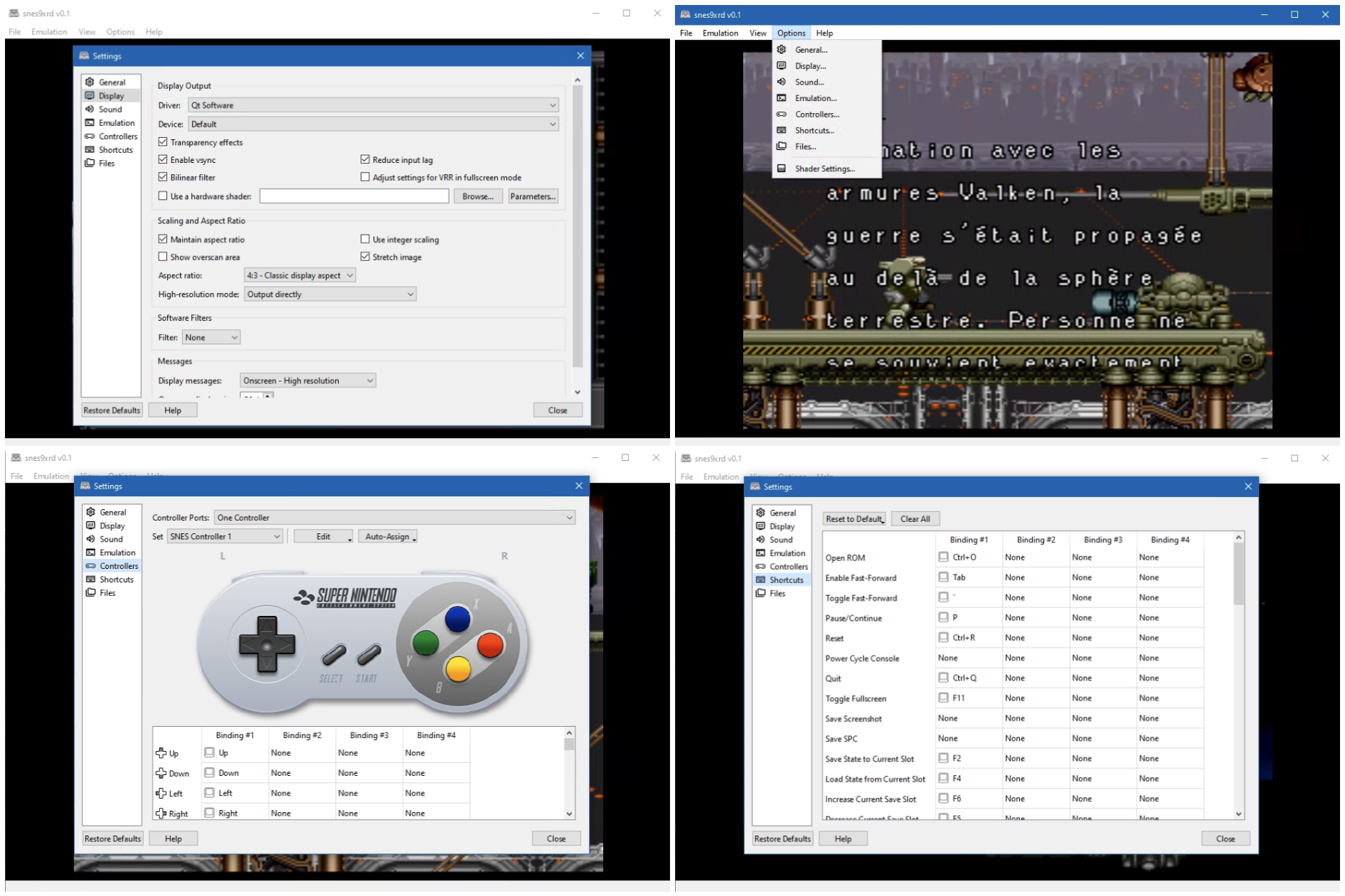
Snes9xrd est un fork personnel de l’émulateur Super Nintendo Snes9x. Il conserve intégralement le cœur d’émulation officiel ainsi que les front-ends GTK, Win32, macOS et libretro, tout en proposant une refonte importante du front-end Qt afin de le rendre plus complet, plus cohérent et plus agréable à utiliser.


L’un des principaux objectifs de ce fork est de rendre l’interface Qt aussi complète que l’interface Win32 en y réintroduisant les fonctionnalités qui lui faisaient défaut. Les paramètres d’affichage, les options de transparence, les shaders, les filtres logiciels, le frame skipping ainsi que les réglages audio avancés sont désormais entièrement accessibles depuis Qt. Les menus d’émulation et de configuration ont également été réorganisés afin d’offrir une présentation plus claire, plus intuitive et plus homogène.
 
Snes9xrd apporte également plusieurs améliorations à la gestion des contrôleurs. Le widget représentant la manette SNES indique désormais avec précision le bouton pressé, sans erreurs de surbrillance, tout en s’intégrant visuellement au thème général de l’interface. La configuration des manettes a été rendue plus fiable: les différents types d’entrées (boutons, axes analogiques et directions) sont correctement distingués, les associations de touches peuvent être sauvegardées et restaurées sans perte d’informations, et les boutons affichés correspondent fidèlement aux entrées réellement détectées.
 
L’interface générale a également été simplifiée. La sidebar expérimentale a été supprimée au profit d’une fenêtre principale plus traditionnelle, organisée autour d’une barre de menus classique. Le menu « Help → About » a été réintroduit et inclut désormais les crédits spécifiques au fork, renforçant ainsi la cohérence de l’ensemble.
 
En résumé, Snes9xrd ne modifie pas l’émulation SNES elle-même, mais vise avant tout à moderniser et à stabiliser l’expérience utilisateur en améliorant l’interface Qt, en fiabilisant la gestion des contrôleurs et en proposant un environnement plus propre, plus complet et plus agréable à utiliser.


Les changements sont les suivants:
 
Qt frontend
– AVI recording: added Start/Stop AVI Recording to the File menu, with an optional Hi-Res mode (Emulation Settings > Recording) that records at the native double resolution used by hi-res and interlaced games.
– AVI recording now stops and finalizes the file automatically when the ROM changes (Open File, Load MultiCart), instead of continuing to record mismatched frames from the new ROM.
– Legacy file menu parity: added a Recent Files submenu, Load MultiCart, and per-slot Save/Load Game Position submenus backed by a state preview dialog (thumbnail + slot picker), matching the legacy Win32 UI.
– Added a Hacks dialog (SuperFX clock speed, overclock, sound interpolation filter, allow invalid VRAM access, separate echo buffer, disable sprite limit) reachable from the legacy-style menu.
– Added a Cheat Search dialog (search/reset/add cheat by value) alongside the existing Cheats list dialog.
– Directories panel: added dedicated folder locations for Movies, SPC dumps, and Satellaview memory packs (ROM/Config/Custom), matching the existing SRAM/States/Cheats/Patches pattern.
– Fixed the SPC dump folder incorrectly resolving to the Export folder.
– Moved the « Auto-Save SRAM » interval control from the Directories panel to the General panel, and made it actually apply to the running core (previously UI-only).
– Made the SRAM interval spinbox’s up/down arrows more visible in the dark theme.
– Game library: widened the Size column’s default width.
 
Fixes
– Fixed a crash: setting the rewind « Frames between steps » to 0 could divide by zero.
– Fixed a data race between the emulation thread and the SDL audio callback thread over the shared audio ring buffer.
– Fixed a data race on the emulation thread’s status flags and its cross-thread main loop callback.


Télécharger Snes9xRD v0.3 (13.4 Mo)

Site Officiel

En savoir plus…

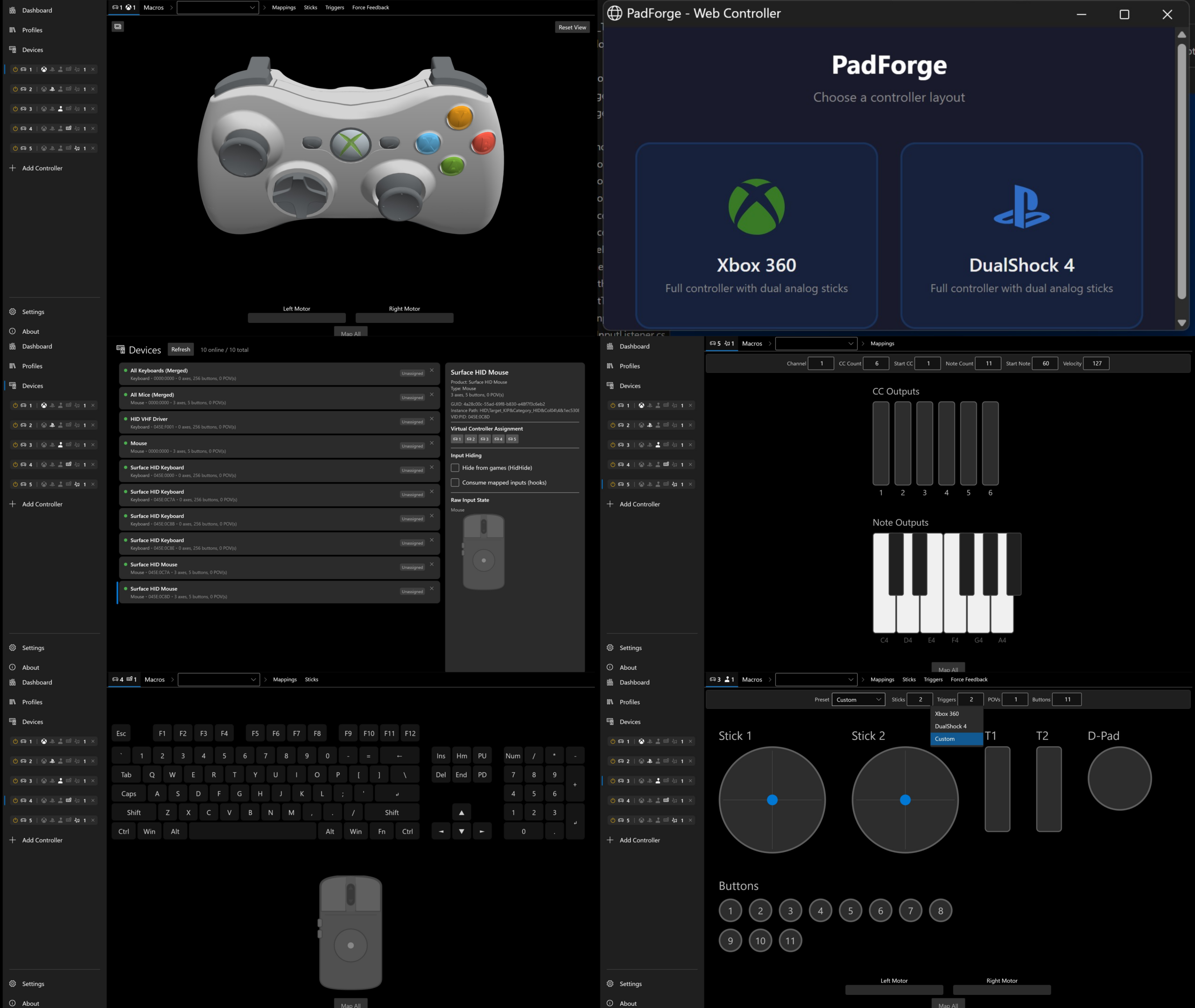
PadForge est un utilitaire moderne de mappage de contrôleurs pour Windows permettant de transformer n’importe quel périphérique d’entrée — manette, joystick, clavier, souris ou écran tactile — en un contrôleur virtuel reconnu comme du matériel réel par les jeux et applications. Il s’appuie sur ViGEmBus, vJoy et Windows MIDI Services pour émettre des contrôleurs Xbox 360, DualShock 4, DirectInput personnalisés, MIDI ou encore un couple clavier+souris virtuel.
 

L’outil autorise le routage libre de toutes les entrées vers jusqu’à seize contrôleurs virtuels simultanés, avec visualisation en temps réel en 2D et 3D, inspection des axes, boutons, triggers et capteurs de mouvement. Les mappages se configurent par enregistrement direct, sélection dans des listes exhaustives ou via un mode « Map All », avec prise en charge des courbes de sensibilité, deadzones avancées, anti-deadzones, offsets, et algorithmes multiples pour sticks et gâchettes.
 
PadForge gère le retour de force, le rumble, la synthèse de vibrations à partir des basses audio, ainsi que la transmission du force feedback DirectInput vers vJoy. Il inclut un système complet de macros permettant de combiner boutons, axes et directions de POV pour déclencher des séquences d’actions (clavier, souris, délais, volume, manipulations d’axes) selon plusieurs modes de déclenchement.
 
L’application peut activer automatiquement des profils selon le programme en cours, basculer de profil via des raccourcis manette, masquer les contrôleurs physiques grâce à HidHide, et installer ou retirer les drivers nécessaires directement depuis l’interface. Un serveur Web intégré permet également de transformer un écran tactile en manette virtuelle avec retour visuel et vibration.
 
PadForge fonctionne sur Windows 10/11 (x64), se déploie en exécutable autonome, propose un polling à 1000 Hz, une localisation dynamique, un mode minimisé en zone de notification et une interface Fluent Design. Le projet est open source sous licence CC BY-NC-SA 4.0 et repose sur de nombreux composants tiers (SDL3, ViGEmBus, vJoy, HelixToolkit, ModernWpf, etc.).


Télécharger PadForge v4.3.0 (297 Mo)

Site Officiel

En savoir plus…

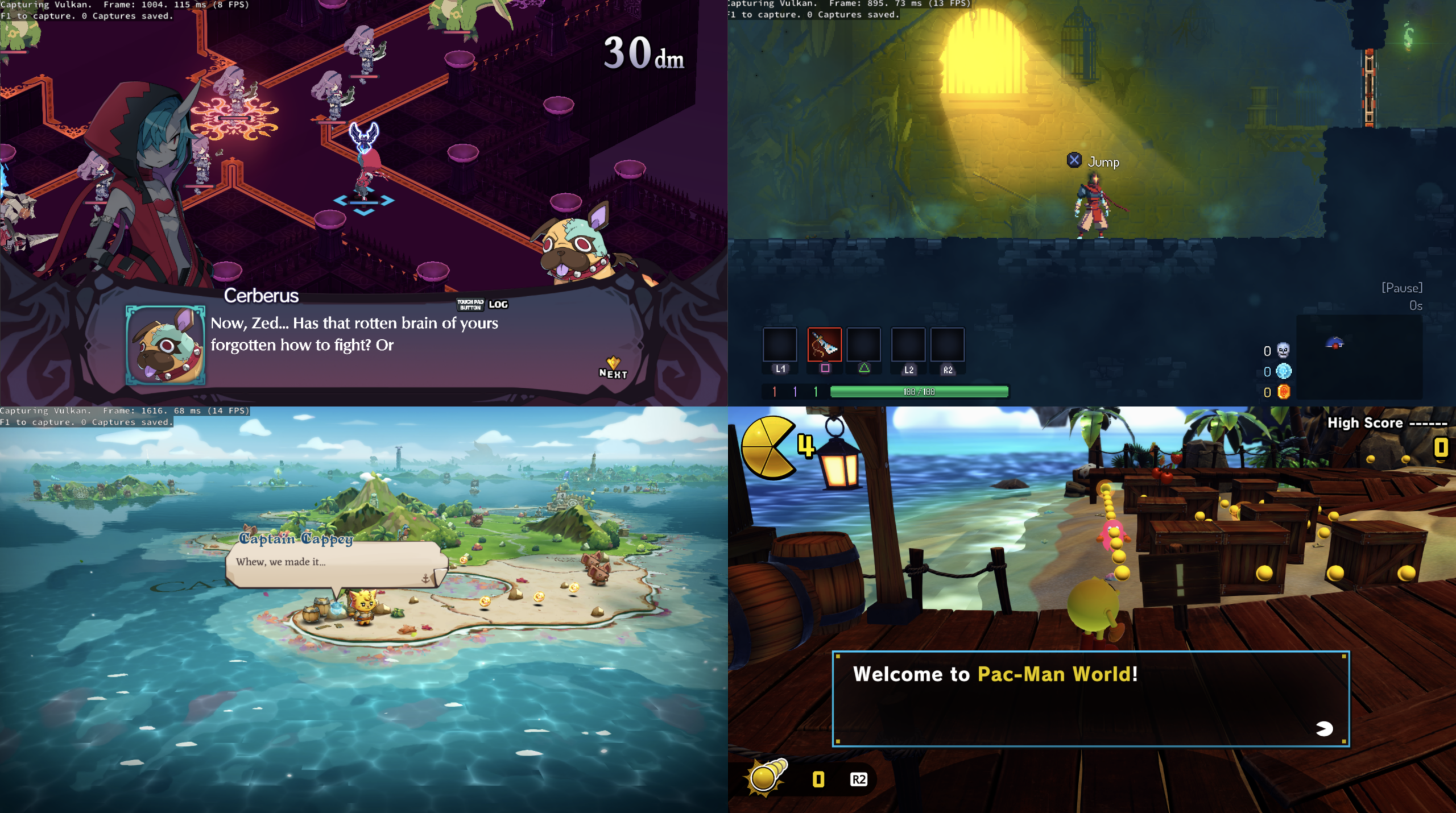
Le projet KytyPS5 est un émulateur PlayStation 5 pour Windows, développé par Nmzik, qui s’appuie sur une version profondément modifiée du Kyty original créé par InoriRus. Il vise à offrir une compatibilité PS5 nettement supérieure à celle du projet initial, en se concentrant sur le démarrage des jeux, la stabilité et la prise en charge progressive des titres commerciaux. L’émulateur est conçu pour fonctionner sans modules LLE externes, ce qui simplifie son utilisation et réduit les dépendances techniques. Le développeur indique que le projet est encore en phase expérimentale, mais déjà capable de lancer certains jeux 2D et plusieurs jeux 3D, avec un objectif clair: améliorer la compatibilité avant de se concentrer sur les performances ou la précision graphique.
 
KytyPS5 fonctionne exclusivement sous Windows et semble optimisé en priorité pour les cartes graphiques NVIDIA, même si d’autres GPU peuvent fonctionner avec des résultats variables. Le projet adopte une approche pragmatique: il cherche d’abord à faire démarrer les jeux, quitte à sacrifier la fidélité visuelle ou la vitesse d’exécution dans les premières versions. Le code est activement développé, avec des mises à jour fréquentes, ce qui en fait l’un des projets PS5 les plus dynamiques actuellement disponibles. Le développeur met en avant une volonté de transparence, en remerciant explicitement InoriRus pour le projet original, tout en assumant une réécriture et une refonte majeure du code.
 
En résumé, KytyPS5 est une continuation non officielle mais assumée du premier Kyty, transformée en un émulateur PS5 moderne, plus ambitieux et plus fonctionnel, qui cherche à devenir une référence dans l’émulation de la console de Sony.


Les changements:
– fix(renderdoc): capture complete guest frames
– test(shader): establish SPIR-V size baselines
– refactor(shader): remove register-state compatibility paths
– refactor(shader): emit SPIR-V declarations on demand
– refactor(shader): emit structured phis natively
– refactor(shader): simplify buffer access emission
– refactor(shader): preserve native wide buffer operations
– refactor(shader): compact whole-quad mask lowering
– refactor(shader): preserve native wide shared operations
– refactor(shader): preserve native scalar memory operations
– refactor(shader): compact paired 64-bit lowering
– refactor(shader): reduce dispatcher state overhead
– refactor(shader): centralize typed resource metadata
– shader: canonicalize CFG loop headers
– shader: dump original RDNA2 binaries in graphics debug mode
– shader: fix shared-terminal selection merges
– Implement RDNA2 per-invocation scratch memory
– graphics: accept independent stencil mask writes
– graphics: derive compute wave size from dispatch mode
– graphics: continue compute on native subgroup size
– shader: initialize compute EXEC from active subgroup
– shader: structurize nested early-exit tails
– shader: reject rejoining early-exit routes
– graphics: grow undersized render target backings
– renderdoc: fix
– shader: implement RDNA2 scalar quad-mask reduction
– graphics: support depth targets with read-only backing
– graphics: preserve raw D16 uint texture reads
– graphics: accept texture-compatible FMASK metadata mode
– shader: canonicalize SampleAdjust sampler scratch bits
– graphics: preserve coherent layered depth layouts
– graphics: honor read-only stencil targets
– graphics: implement RDNA2 D16 image packing
– graphics: preserve FP16 inline constants
– videoout: support PS5 auxiliary buses
– agc: new ABIs
– shader: honor RDNA2 128-bit image descriptors
– gpu: route direct shader register ranges through handlers
– gpu: handle partial guard-band register ranges
– agc: emit native wait-on-address packets
– launcher: window title fix
– gpu: handle native blend-color register writes
– agc: initialize interpolant mapping registers
– gpu: describe packed 11-11-10 uint textures
– shader: support bit-packed image surfaces
– shader: separate formatless storage from image atomics
– shader: accept byte-selected CNDMASK SDWA operands
– shader: align address-memory buffer bindings
– agc: new ABI
– commandProcessor: WriteData fix

 
(Temporary build compiled from this fork pending official releases.)


Télécharger KytyPS5 r260821 (19.7 Mo)

Site Officiel

En savoir plus…

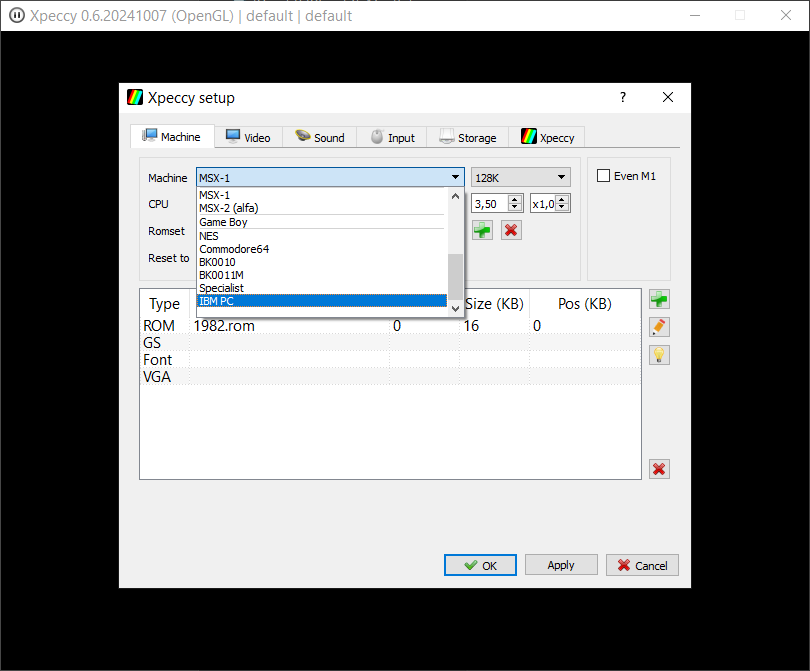
Également disponible sous Linux, Xpeccy est un excellent et complet émulateur de:
 
– ZX Spectrum 48K
– Spectrum +2
– Spectrum +3
– Pentagon (128-512K)
– Pentagon 1024 SL
– ZS Scorpion (256,1024) + ProfROM
– Pentagon 1024SL
– ZXM Phoenix
– Profi
– ATM Turbo 2+
– ZXEvo BaseConf
– ZXEvo TSConf
– Alf TV Games
– MSX1 (beta)
– MSX2 (beta)
– Gameboy color
– NES/Dendy (beta)
– Commodore 64 (pre-alpha)
– БК0010/БК0011M (pre-alpha)
– IBM PC/AT (286) (pre-alpha)
 
Forum alternatif


Télécharger Xpeccy v0.6 (2026/08/20) (9.8 Mo)

Télécharger Xpeccy (Win QT Libraries) (9.4 Mo)

Site Officiel

En savoir plus…


Casino-en-ligne-fiable.com

https://getourbonus.com/fr/accueil

https://www.romspedia.com/

https://www.casinoonlinefrancais.fr

Lucky 7 bonus

https://www.casinogratuitsansdepot.com

pablocasino.org

critiquejeu.info

casinodoc.org

laplanquedujoueur.com

casinoonlinefrancais
Listing de toutes les actualités , Page numéro 20 - Emu-France

Qemu est un émulateur basé sur la translation dynamique de code, qui lui permet d’obtenir de très bonnes performances. Il permet actuellement d’exécuter des programmes pour ix86, arm, sparc et powerpc sur diverses plateformes (PC, PPC, alpha, arm, sparc, amd64, mips, ia64, …) et de lancer des OS pour PC ou PPC. Inclus les images systèmes et les fichiers bat pour i386, mipsel, arm, sparc et PCC. QEMU émule en permanence le processeur et cela peut réduire la performance d’un facteur cinq à dix. Pour pouvoir obtenir des performances plus comparables à un système non virtualisé ou à VMware (réduction de performance d’un facteur 1 à 2 seulement), il faut utiliser un module d’accélération, ce qui nécessite un système Linux sur architecture x86 ou x86_64 avec un noyau 2.4.x ou 2.6.x.
 
Qemu
 
Les changements sont visibles ici.


Télécharger QEMU (x86) v7.2.0 (152 Mo)

Télécharger QEMU (x64) v11.1 (197 Mo)

Site Officiel

En savoir plus…

Panda3DS est un émulateur Nintendo 3DS sur le thème du panda roux, écrit en C++ et utilisant le HLE.


Les changements sont visibles ici.
 

Télécharger Panda3DS v0.9 Build 260812 (37.5 Mo)

Site Officiel

En savoir plus…

Il s’agit d’une petite application qui fonctionne comme une superposition et vous permet d’ajouter des scanlines sur les jeux pc, émulateurs, interface graphique de la manière la plus simple possible.
 

Que le programme propose des scanlines ou non, vous pourrez ici en appliquer en toute simplicité.


Un tuto est visible ici.
 
Voici les changements:
 
★ BEZEL REFLECTION
4:3 games are now fully supported :
The reflection finally hugs the edge of the image on 4:3 games, not just 16:9.
 
• Corner geometry fixed : rounding the corners no longer stretches or distorts the reflection
• Two separate size sliders : up/down and left/right, with an option to link them
• New AUTO / LOCK / FULL button to choose how the reflection frames the game

 
★ NEW FEATURES

Factory presets :
A full library of ready to use presets built by myself, covering consoles, handhelds, arcade and 16:9 games. Check them first when you add a new game, they will save you a lot of tweaking.
 
In-game menu (OSD) :
The same settings panel, directly inside your game, for titles that hide the S4W window. Controllable with your mouse or fully with a gamepad.
 
Report button :
Tell me how a game behaves in a few clicks, the right log file is attached automatically.
• SNAP TO PIXEL : locks the scanline grid onto the game’s internal pixels
• New Kill Game shortcut to close the running game instantly
• Gamepad support (XInput) : assign your shortcuts to gamepad buttons, not just to the keyboard

 
★ COMPATIBILITY
• MAME per game profiles : a different bezel and different settings depending on which MAME game is running

 
★ BEZELS
• New 4K bezels that stay sharp even if you are not running in 4K

 
A télécharger sur le site officiel.
 

Site Officiel

Un émulateur de MZ-800 / MZ-700 / MZ-1500 pour Windows.


Les changements principaux sont:

– The emulator can now be built on macOS as well (guide: docs/build_osx.md). Thanks to Mathias Olsson for the contribution.
– BUGFIX: macOS – the emulator crashed shortly after start while updating the main window title. (GitHub issue #2)
– BUGFIX: Debugger – a MEM_W/MEM_R breakpoint incorrectly triggered already when an instruction at the watched address was executed.
– BUGFIX: Debugger – MEM_W/MEM_R and IORQ breakpoints only worked while the Disassembled window was open. They now work without the Disassembled #1 window open too.
– Debugger – for a memory-access breakpoint in the memory bank zone (MMEXT_BANK) you can now choose how the entered address is read: either as an address in the CPU view (0000-FFFF), or as an offset within the bank (e.g. 0000-1FFF). The offset within the bank catches an access to that bank regardless of which CPU window the bank is currently mapped into.
– BUGFIX: Trace Suite – turning recording off (or changing a channel mode) from the menu while emulation was running could crash the emulator. Recording is now started and stopped safely on the emulation thread.
– CHANGE: Trace-suite recording now has a default size cap of 2 GB per channel (previously unlimited) so a long recording (mainly CPU Track) cannot fill the disk. When reached, the channel stops; the cap is configurable (max_total_mb, 0 = unlimited).
– BUGFIX: fixed timing in the z80-mz800 CPU core – the CPU executed an interrupt immediately after EI instead of after the following instruction. The bug was introduced in version v2.0.2
– BUGFIX: In IM 2 mode, when an interrupt that did not originate from the PIO-Z80 arrived, we previously returned the vector 0x00 incorrectly. Now the « bus ghost » value is returned. A minor fix was also added in the I/O Ports window and the Events window. Snapshot: loading a snapshot corrupted the Unicard SD root dir configuration.
– MCP server – events are now available over TCP as well (previously only over the pipe). Typed breakpoints (MEM_W, MEM_R, IORQ…) can be created. Instruction tracing can be fully controlled over MCP (start/stop/reset/save, with channel selection). MCP tools now always return an error message instead of an empty response on error.
– BUGFIX: MCP server – sending keys to the emulator now reports whether the keys actually landed. Previously the tool could report success even when the machine did not accept them.
– Tracing can now be limited to an address range (PC filter).
– A breakpoint action can run additional commands – control tracing and CDL recording (start/stop/reset/save) and save a snapshot or a memory segment right from the breakpoint (including a continuing one), with a file name template.
– BUGFIX: MCP server – emu_run now stops emulation deterministically (exactly at the requested frame count). Previously the asynchronous pause stopped it at a variable point, so tracing over MCP could nondeterministically affect timing-sensitive programs.
– MCP server – the emu_run response now includes a stopped_by field (why the emulation stopped: ran the full frame count, breakpoint, pause or timeout); the complete field is now true only when the full requested frame count was reached.
– SPEEDUP: The emulation is significantly faster in MAX SPEED mode. Thanks to Z80 core and memory access optimizations it now runs about 42 % faster (up to ~47 % on memory-heavy code). Specifically: a per-step Z80 core variant without the internal register cache (+27 %) and direct (inline) access to plain RAM instead of going through a function pointer (+11.6 % to +15.6 %).
– BUGFIX: Unicard – the short file name field (8.3 format) in the directory listing and file status contained only a truncated long name instead of a valid 8.3 name for long file names. The emulation now generates the same 8.3 name as a real card.
IMPORTANT: it turned out that each Unicard firmware version fills this field DIFFERENTLY – and the emulation now reproduces BOTH variants. Firmware uc1 (MZ800UKP1) preserves letter case (e.g. « seesharp.mzf » stays lowercase); firmware uc3 (Unicard3) uses uppercase only. The emulation picks the correct variant based on the active firmware.
– BUGFIX: Unicard – the binary directory listing and file status now also faithfully fill the long name field and its length, according to the active firmware (uc1 and uc3 fill these fields differently – on uc1 the long name is sent only for files that actually have one, on uc3 this field carries the primary name). As a result, code tested against the emulator also works on real HW. Firmware uc1 additionally sends a « .. » entry in subdirectories (uc3 does not – its manager adds it itself).
– CHANGE: A bug was found in the Unicard uc3 (Unicard3) firmware – in the binary directory listing it does not fill the long file name (LFN) field. In this point the emulator deliberately behaves CONTRARY to the accurate-emulation principle: it emulates uc3 the way we believe it should behave IF the bug were not there (i.e. filling the LFN correctly). For this reason, uc1 (which is faithful to the real HW) is now the default Unicard firmware for MZ-800.
– BUGFIX: the main window was not placed at the center of the screen at startup on lower-resolution displays when a startup window size other than « Native » was selected. The window is now centered for all sizes, including after leaving full-screen mode.
– BUGFIX: MCP server – direct physical memory access (region_read/region_write and the file_load/save_from_region composites) was unreliable in some situations: reading large regions (around 64 KB) over TCP stalled the connection, and region IO failed until the debugger was opened. It now works reliably even for full 64 KB regions and right after startup; on error it returns a clear message instead of an empty response.
– BUGFIX: On-the-fly reads from the CTC 8253 occasionally returned a wrong value. The bug was introduced in v2.0.2 when the emulation was split into the DBG and HOT paths.


Télécharger Mz800emu v2.0.5 pre (42.0 Mo)

Site Officiel

En savoir plus…

Coffee GB est un émulateur Game Boy Color développé en Java 16 (pour le cœur) et Kotlin (pour l’interface graphique). Conçu comme un projet personnel et un exercice de programmation, il se distingue par une approche technique ambitieuse: l’émulation du CPU est cycle-exacte, chaque instruction étant décomposée en micro-opérations exécutées à la cadence réelle de la console.
 

Malgré son aspect expérimental, Coffee GB offre une compatibilité élevée, validée par les célèbres tests Blargg et Mooneye GB, garantissant un comportement fidèle à la console d’origine. Il prend en charge les cartouches avec les contrôleurs mémoire MBC1 à MBC5, ainsi que les sauvegardes sur batterie, permettant de conserver les données de jeu comme sur une vraie Game Boy.
 

L’émulateur lit également les ROMs compressées (.zip), propose une configuration des touches via un fichier .properties, et intègre une fonctionnalité de netplay avec rollback (encore expérimentale) pour jouer en ligne avec synchronisation des états.
 

Pour les développeurs ou curieux techniques, le projet inclut des tests automatisés via Maven, et le code source est disponible sous licence MIT, librement modifiable et réutilisable.


Télécharger Coffee GB v2.0.4 (79.2 Mo)

Site Officiel

En savoir plus…

Mesen Community Edition est un émulateur multi‑systèmes open‑source pour Windows, Linux et macOS, développé par la communauté à partir du projet Mesen2. Il vise une haute précision, une excellente compatibilité, et propose une interface moderne accompagnée d’outils avancés pour les joueurs comme pour les développeurs.


Né initialement comme un fork pour pallier la mise en pause du développement de Mesen2 par son créateur original (Sour), MesenCE est désormais devenu la continuation officielle et exclusive du projet. Face à la dynamique communautaire, Sour a choisi de rejoindre activement l’équipe de MesenCE afin d’y centraliser tout le développement futur. Cette transition sous un modèle entièrement géré par la communauté permet d’intégrer plus rapidement les correctifs, d’améliorer la compatibilité multiplateforme et d’ajouter de nouvelles fonctionnalités, tout en préservant l’esprit d’excellence du projet d’origine.
 
Les changements:
 
Mesen is becoming MesenCE, a Community Edition maintained by Sour and various community members. All development will occur in this new fork going forward so it can continue whenever Sour is away from the project.
 
– Debugger: Tilemap viewer – Added option to pick background color (#238)
– Debugger: Lua – Added getPressedKeys API (#236)
– Debugger: GG/SG/CV – Sprite Viewer – Added support for zoomed sprites (#235)
– Debugger: SuperGrafx – Added VPC options and VDC1/VDC2 filter in the event viewer (#234)


Télécharger MesenCE v2.2.1 r20260819 (70.1 Mo)

Site Officiel

En savoir plus…

Il s’agit d’un fork de l’émulateur Switch Citron, repris exactement à l’endroit où son développement s’était arrêté.


Les changements:
– video_core: share arm64 register guard assembly
– video_core: address ARM64 register guard review
– video_core: isolate ARM64 CallMethod frame corruption
– video_core: isolate ARM64 draw frame corruption
– video_core: contain ARM64 draw ABI corruption
– video_core: isolate ARM64 pipeline configure ABI corruption
– video_core: harden ARM64 macro call guard
– video_core: guard macro calls from ARM64 ABI corruption
– video_core: diagnose macro interpreter faults
– Merge pull request #229 from cheezwiz7899/prevent-stale-bindless-cache
– Merge remote-tracking branch ‘origin/main’ into prevent-stale-bindless-cache
– optimize: combine bindless cache lookup and slot acquisition
– Merge branch ‘main’ into prevent-stale-bindless-cache
– vulkan: remove half-baked last_bytes_hash from bindless cache
– vulkan: reduce bindless cache size from 64 to 16
– vulkan: fix bindless cache staleness on TIC generation change
– Merge pull request #273 from cheezwiz7899/bindless-nonuniform-decoration
– fix(shader_recompiler): avoid mutating original ids in BindlessArrayIndex
– spirv: decorate bindless descriptor indices as NonUniform
– Merge pull request #294 from Splaser/codex/pr285-vram-gc
– Address VRAM GC follow-up review
– video_core: address VRAM GC review feedback
– frontend: remove obsolete VRAM limit
– frontend: remove obsolete GC controls
– vulkan: decouple allocator recovery from cache GC
– video_core: restore passive cache GC
– Document Vulkan memory usage fallback semantics
– Fix Vulkan memory budget shadow warning
– Fix Vulkan memory budget tracking and cache reclamation
– Refine VRAM pressure tracking and cache garbage collection
– Track global Vulkan memory usage for VRAM pressure and reporting
– Avoid deadlock during recursive Vulkan memory recovery
– Synchronize Vulkan memory-pressure callback updates
– Merge pull request #293 from Splaser/codex/android-hle-keyboard-composing
– android: clarify inline IME input comment
– android: allow composing text in HLE keyboard
– Merge pull request #292 from Splaser/codex/fix-content-management-dumps
– fix: list packaged updates in addons
– docs: clarify Android dump parameters
– fix: distinguish packed content and repair Android dumps
– Merge pull request #291 from Splaser/codex/xci-ticket-import
– file_sys: import tickets from merged XCI partitions
– Merge pull request #286 from cheezwiz7899/build-fixes2
– spaces are evil
– Merge branch ‘main’ into build-fixes2
– fix AppImage packaging cleanup
– fix(windows) make the csgenerate stage respect the release type
– more dependency package adjustments
– move bolt building to the bolt stage where it belongs
– update packages for various distros in setup
– fix msys2 path handling bug with ffmpeg compile
– some profraw handling improvement for clang-cl pgo stages, and qt path tomfoolery
– Merge branch ‘citron-neo:main’ into build-fixes2
– build(windows):fix pgo profile handling for clang-cl, enable libusb for clangtron


Télécharger Citron Neo (2026/08/08) (59.8 Mo)

Site Officiel

En savoir plus…

L’objectif de ce projet est d’être un émulateur Nintendo DS rapide et portable.


Télécharger NooDS (32 bits) (2020/06/14) (2.5 Mo)

Télécharger NooDS (64 bits) (2026/08/10) (3.6 Mo)

Site Officiel

En savoir plus…

Il s’agit d’un bon émulateur de Commodore C64.


Télécharger CCS64 (Dos) v2.0B (348 Ko)

Télécharger CCS64 (Win98+) v3.9.2 (2.0 Mo)

Télécharger CCS64 v4.1 (43.4 Mo)

Site Officiel

En savoir plus…

XRoar est un émulateur Dragon32/64 mais aussi Tandy CoCo.


– Internal rework of breakpoints and watchpoints
– Target description sent to GDB
– Enable GDB for MC-10
– GDB: support NoAckMode
– New option -gdb-pseudo-regs exposes more state as faux registers to GDB
– SDL3 support
– Windows UI migrated to use SDL3
– New option -vo-monochrome selects black & white display [by Erik Gavriluk]


Télécharger XRoar (x86) v1.12 (2.5 Mo)

Télécharger XRoar (x64) v1.12 (2.5 Mo)

Site Officiel

En savoir plus…

Le projet KytyPS5 est un émulateur PlayStation 5 pour Windows, développé par Nmzik, qui s’appuie sur une version profondément modifiée du Kyty original créé par InoriRus. Il vise à offrir une compatibilité PS5 nettement supérieure à celle du projet initial, en se concentrant sur le démarrage des jeux, la stabilité et la prise en charge progressive des titres commerciaux. L’émulateur est conçu pour fonctionner sans modules LLE externes, ce qui simplifie son utilisation et réduit les dépendances techniques. Le développeur indique que le projet est encore en phase expérimentale, mais déjà capable de lancer certains jeux 2D et plusieurs jeux 3D, avec un objectif clair: améliorer la compatibilité avant de se concentrer sur les performances ou la précision graphique.
 
KytyPS5 fonctionne exclusivement sous Windows et semble optimisé en priorité pour les cartes graphiques NVIDIA, même si d’autres GPU peuvent fonctionner avec des résultats variables. Le projet adopte une approche pragmatique: il cherche d’abord à faire démarrer les jeux, quitte à sacrifier la fidélité visuelle ou la vitesse d’exécution dans les premières versions. Le code est activement développé, avec des mises à jour fréquentes, ce qui en fait l’un des projets PS5 les plus dynamiques actuellement disponibles. Le développeur met en avant une volonté de transparence, en remerciant explicitement InoriRus pour le projet original, tout en assumant une réécriture et une refonte majeure du code.
 
En résumé, KytyPS5 est une continuation non officielle mais assumée du premier Kyty, transformée en un émulateur PS5 moderne, plus ambitieux et plus fonctionnel, qui cherche à devenir une référence dans l’émulation de la console de Sony.


Les changements:
– Embedded fetch shader: Fix overlapping buffer loads by @Nmzik in #133
– Optimize bulk memory invalidation by @Nmzik in #124
– Optimize texture cache tracking by @Nmzik in #123
 
(Temporary build compiled from this fork pending official releases.)


Télécharger KytyPS5 r260821 (19.7 Mo)

Site Officiel

En savoir plus…

SuperSNES9X est un fork avancé de SNES9X, développé par shanytc, qui ajoute de nombreuses améliorations modernes tout en conservant la rapidité et la simplicité du SNES9X original. Il vise autant les joueurs (retroachievements, online) que les créateurs (sprite ripping, hacking, debugging).


Principales améliorations:
– Support multi-système : GameBoy, GameBoy Color et Super GameBoy intégrés
– RetroAchievements intégrés
– Kaillera (Client/Serveur) pour le jeu en ligne
– Run‑Ahead pour réduire la latence d’entrée
– Correction colorimétrique et filtres CRT‑like
– Viewers S-PPU avancés (Sprites/Tiles) pour rippers et map‑makers
– Cheat Search & Editor améliorés : clic droit, fonctions batch
– Assignation Multi-Bind: mixage clavier + manette sur une même entrée
– Support SDL (Simple DirectMedia Layer)
– Pack multilingue
– Convertisseur de sauvegarde SNES9X <-> MESEN, disponible ici.
 
A noter que les fichiers de configuration et sauvegardes sont 100% compatibles entre SNES9X et SuperSNES9X.
 
Les changements sont:
 
Super FX 3 (FX3) — New Chip Support
– Thanks to the legendary Randy Linden!
– New cart types $17 (FX3) and $18 (FX3 + battery), detected alongside the classic GSU codes.
– GSU MMIO relocated to $7000–$7FFF (mirroring every $400, $x300 quarter reads open bus); the old $3000 window and $6000–$7FFF RAM window are gone.
– ROM banking widened to 4 MB for both the GSU and the CPU ($C0–$FF); RAM only at $70–$71.
– ~4x GSU clock in both cycle and legacy timing modes, stacking with the SuperFX clock multiplier.
– No SCMR RON/RAN bus arbitration; any ROM or RAM program bank is runnable.
– STOP resets R15 to 0 — the FX3 has no completion IRQ; the CPU polls R15 from its V-IRQ.
– MERGE repurposed as a command port keyed on R0: chunky-to-planar conversions (0–2) and framebuffer-third clears (3–5).
– VCR reads $52. Savestates need no format change — the FX3 flag is re-derived from the cart on load.
 
SNES Rumble (Shake) Support
– Support for the Port-1 pass-through rumble dongle the 2026 LRG carts drive (Tested with RT.SFC Rumble test demo).
– The core decodes the WRIO ($4201) bit-bang protocol — one bit latched per $4016 read-clock, preamble $72, then right/left motor magnitudes.
 
Street Fighter EX Plus Alpha – Protection Simulation
– The pirate cart’s protection chip is now simulated, so the game finally runs: boot, menus, player select, full rounds with fighters, timer, damage, and round transitions.
– Without the chip’s three answers the game black-screened on boot (APU upload overran into the IPL), drew HUD-but-no-fighters, or hit the « CPU is deadlocked » crash via a 2-byte-per-frame stack leak.
– The patch is pinned to the dump’s CRC32 plus 12 code-byte matches, and the ROM-info dialog still identifies the original pre-patch dump.
 
Game Boy / Super Game Boy
– Sachen MMC1 open bus: banks past the end of the ROM chip now read $FF instead of mirroring — fixes Rocman X Gold + 4 in 1 hanging forever on its boot-logo probe loop. All 17 Sachen carts in the test set A/B-verified.
– Sachen RA7-high logo detection: carts that keep the Nintendo logo in the RA7-high half of the scrambled window (« 4 in 1 + 8 in 1 » and its three siblings) are now detected instead of booting to the SGB red-X reject screen.
– MBC5 multicart base/mask banking: the 23 in 1 (Taiwan) menu’s $5001/$5002 registers are implemented, so its sub-games (Super Mario 3, GB DBZ Gokou, Tarzan, Tetris, …) actually launch. Ordinary MBC5 carts are untouched.
– SGB BIOS mode powers on with the LCD off, matching hardware — fixes the GB boot logo rendering as scattered tile fragments (Balloon Fight GB, Castlevania Legends). A mid-splash warm reset now power-cycles instead of stranding the BIOS on a half-drawn logo.
 
RetroAchievements
– Full pass over the RA maintainer review’s issue list.
– The achievement list is modeless (the game keeps running), refreshes live once a second, and gains Progress and Type (Missable / Progression / Win Condition) columns plus a game/user summary header.
– Hardcore now permits fast-forward/speed-up (RA rules only forbid sub-100% speeds); slow-mo, frame-advance, and rewind blocks show OSD notices instead of failing silently.
– Real login feedback: server errors in a MessageBox, success confirmation with points, empty-field validation. Toasts expire in wall-clock time so a later ROM load doesn’t replay a stale backlog.
– Menu shows Logout (); new View Profile item opens the RA profile page.
– Logging in with a game running hard-resets once the game is identified (single posted reset; the hardcore toggle no longer resets twice).
– Netplay (snes9x netplay or Kaillera) suspends achievement processing so remote players’ inputs can’t earn unlocks on this account; triggers re-arm when the session ends.
– libretro: GB memory maps are exposed to the frontend, so GB achievements finally evaluate against GB WRAM instead of never firing — also fixes RetroArch cheat search for GB games.
 
SFC-Box
– The keyswitch 2/3 trial banner now reads « Free play in progress », and the check-play banner and minutes-only trial countdown are translated (« Time left N min »).
– gtk/qt builds compile the supervisor-board sources (sfcbox.cpp, hd64180.cpp) they were missing.
 
Input (win32)
– Controller auto-assign is now user-pickable and newly plugged pads no longer hijack configured slots (#178): the Input Config device label is a dropdown of all detected controllers, and the free-slot fallback skips slots whose saved GUID belongs to another (possibly unplugged) device.
– Duplicate controller names now get numbered suffixes in the device dropdown.
 
Libretro
– Decoded values go through the frontend rumble interface (strong=left, weak=right).
 
Win32 / UI
– Added Input → Enable Rumble (Shake) toggle (persisted, default on) drives the SDL gamepad holding Port 1’s bindings; rumble auto-stops on pause/exit.
– Registry file associations are opt-in (#180): AddToRegistry defaults to off, registration uses a SuperSnes9x identity instead of squatting on official Snes9x’s, stale per-exe entries are swept (including renamed copies), and the Settings checkbox applies immediately.
– i18n: translated dialog controls are measured and sized at runtime with the control’s real font (33 languages, English layouts untouched); the menu-localization cache is keyed by command ID so the runtime-inserted BIOS popup no longer scrambles the Emulation menu on language switches.
– Cheat search watch buttons moved clear of the Data Size group box (spotted by Nekokabu in PR #181).
 
Bootable Games:
– Astro Hawk (PD)
– Street Fighter EX Plus Alpha
– StarFox 1 (FX3) – Patch the .bps onto StarFox
– StarFox 2 (FX3) – Patch the .bps onto StartFox 2
– Ultimate Doom (FX3)
– Rocman X Gold + 4 in 1
– 4 in 1 + 8in 1 (and its three siblings)


Télécharger SuperSnes9x v1.63.29 (11.2 Mo)

Site Officiel

En savoir plus…


Casino-en-ligne-fiable.com

https://getourbonus.com/fr/accueil

https://www.romspedia.com/

https://www.casinoonlinefrancais.fr

Lucky 7 bonus

https://www.casinogratuitsansdepot.com

pablocasino.org

critiquejeu.info

casinodoc.org

laplanquedujoueur.com

casinoonlinefrancais