

Pureikyubu est un émulateur de Nintendo GameCube en cours d’élaboration basé sur Dolwin.
Le but de l’émulateur est de rechercher les caractéristiques matérielles de la GameCube et de faire de la rétro-ingénierie sur les technologies utilisées pour développer des jeux pour cette plateforme.
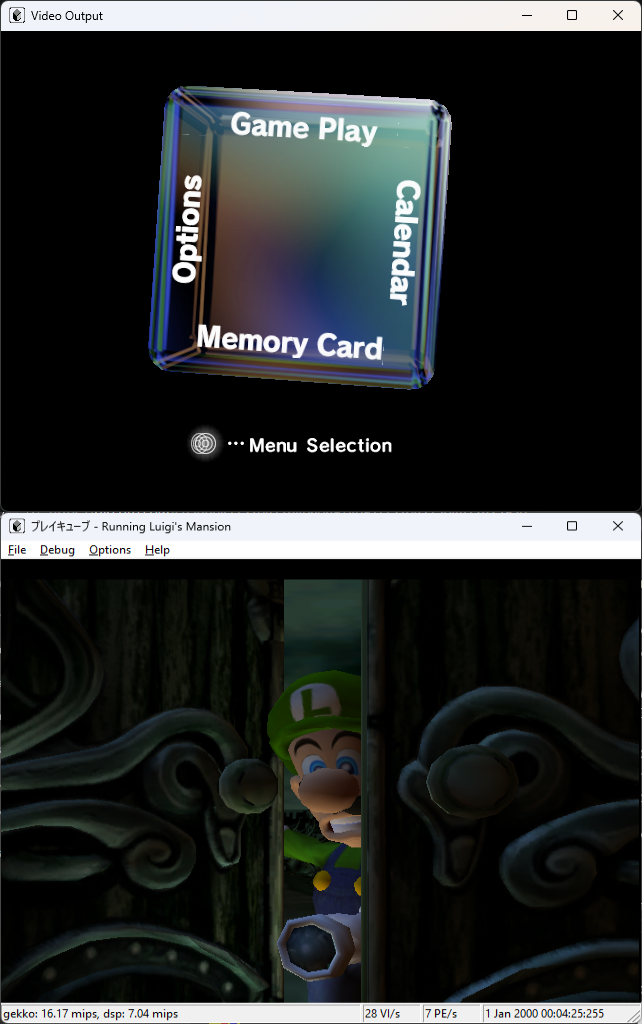
Version 1.7 is the largest update since the project started. The graphics backend was rebuilt around the two programmable stages of Flipper, the emulator finally has automated tests for its two most complex subsystems, the SDL build became a first-class front end with sound and a game selector, and a set of CPU and memory bugs was cleared that lets a Linux kernel boot on the emulated console.
The long-form version of these notes, with a timeline and screenshots, is in the digest of the work after release 1.6.
Highlights
– Shader-based graphics. The Flipper Transform Unit and Texture Environment Unit are emulated by GLSL 3.30 vertex and fragment shaders on the OpenGL 3.3 core profile; the fixed-function pipeline is gone. The Command Processor now feeds the XF instead of reaching into the graphics blocks.
– The GFX pipeline is tested. 340 unit tests run the real CP -> XF -> SU -> RAS -> TX -> TEV -> PE pipeline against an OpenGL context and publish an HTML report with 262 rendered reference pictures. The suite found and fixed a large batch of long-standing rendering bugs.
– The DSP core is tested against the hardware. 177 tests, 1822 golden ALU vectors and 435 circular-buffer vectors; the DSP IROM is fully disassembled and analysed.
– GC-Linux boots. Fixed GQR/paired-single decoding, the cache-coherent MMU hash-table walk, the decrementer model, mtcrf, lswi/lswx and the SI registers. A 2004 kernel reaches the gcnfb console with the Broadband Adapter driver loaded.
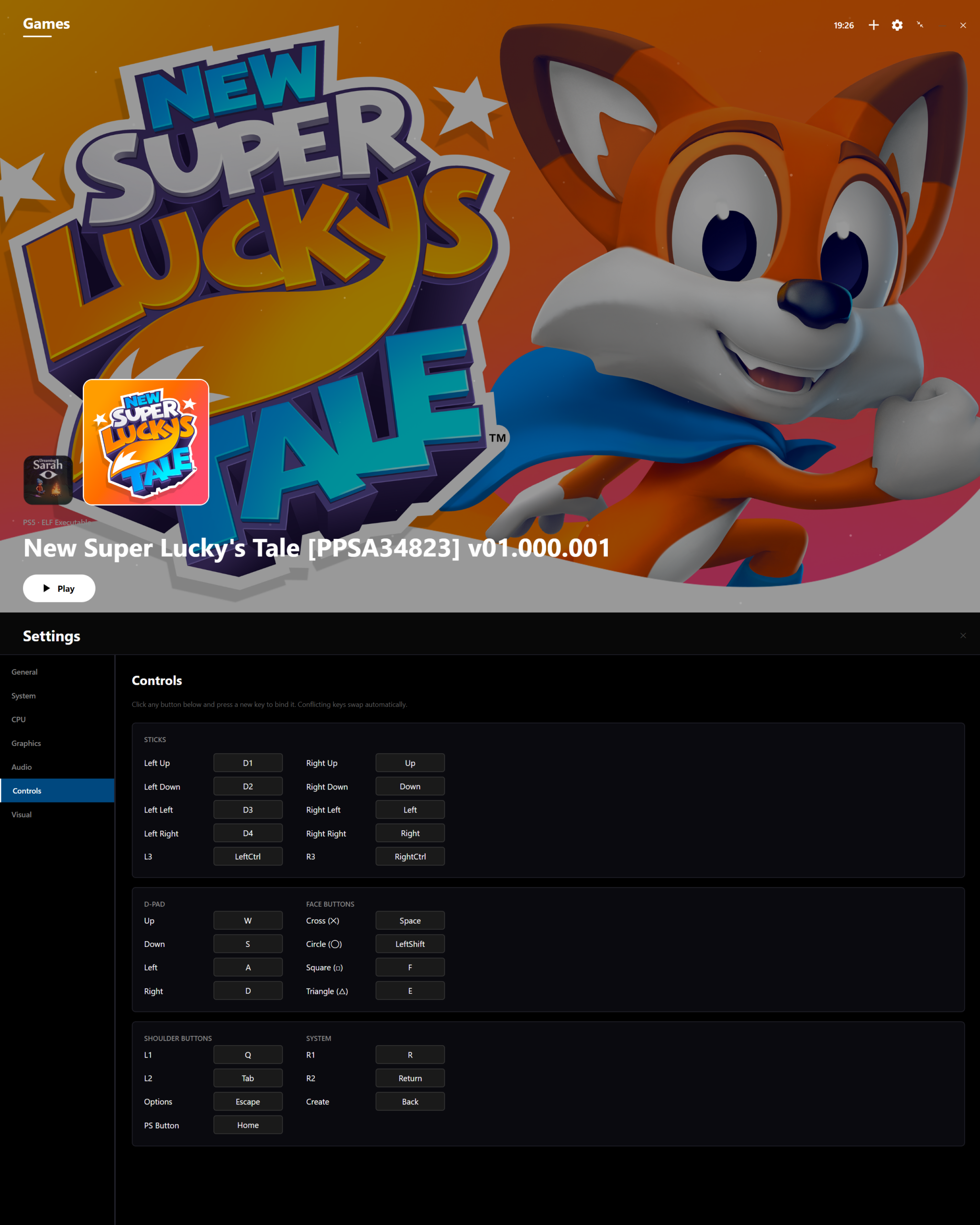
– Games. The Metroid Prime intro movie plays and the game reaches its title screen; Zelda: The Wind Waker gets past its boot; Ikaruga’s THP title movie has correct colours; PONG runs again.
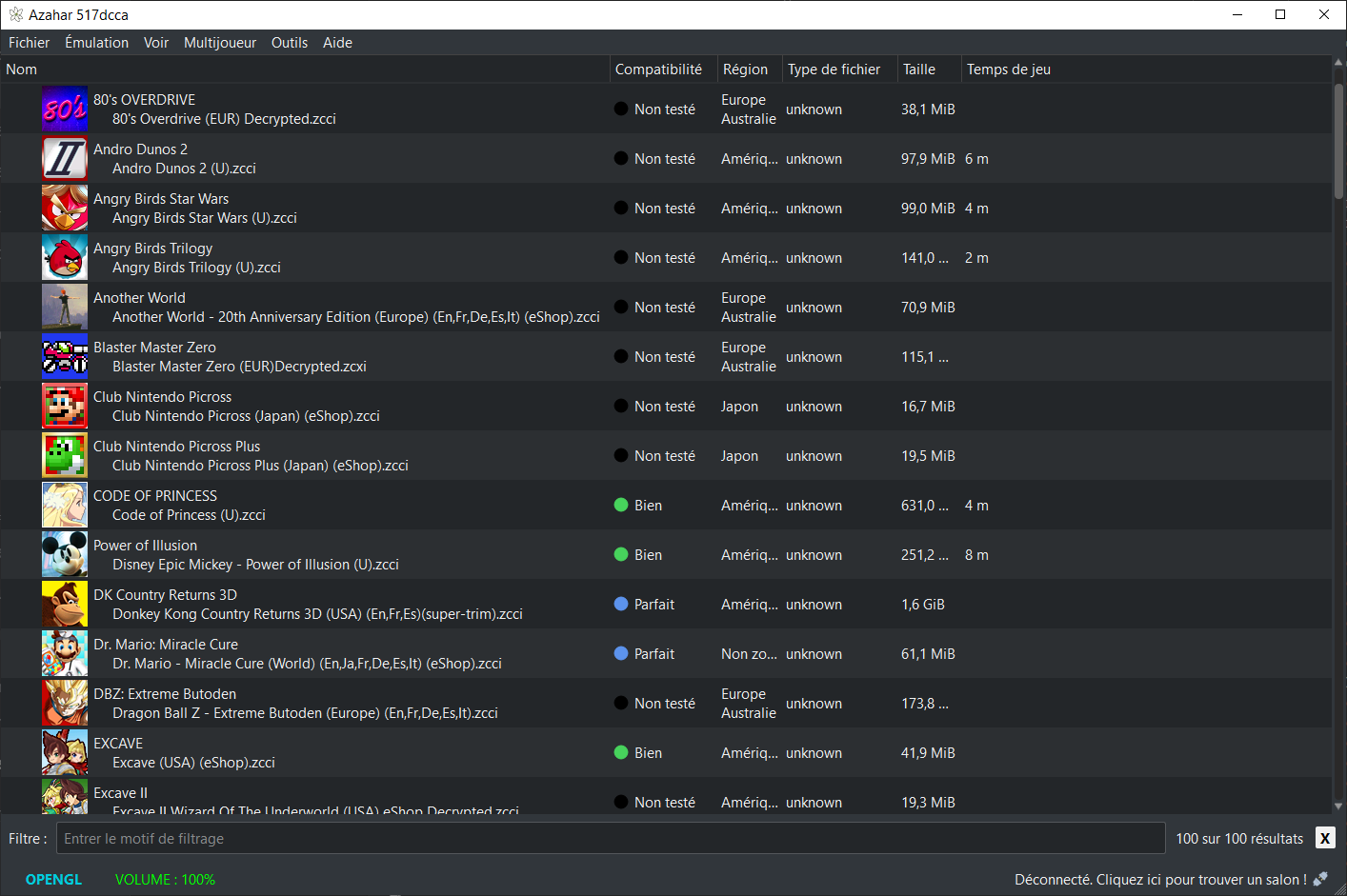
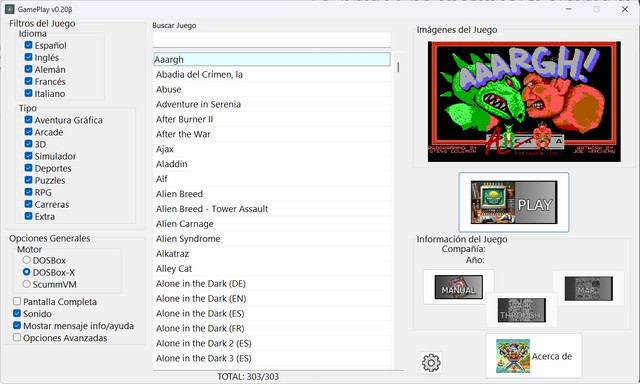
– SDL front end. Sound, an integrated file browser, message boxes and the full game selector (banners, Game IDs, sorting, filters, jump-to-letter) are available in the cross-platform build.
Added
Graphics
– GLSL 3.30 vertex shader emulating the XF: geometry and texture matrix multiplies, the projection combine, per-vertex lighting for both colour channels and all texture coordinate generation modes.
– GLSL 3.30 fragment shader emulating the TEV: up to 16 combine stages, the full operand/bias/sub/clamp/shift datapath, Rev-B K constants, fog and the final alpha function. Both shaders are static and receive the register state as uniforms.
– Independent decoding and binding of all eight texture maps, mip-level generation and the corrected sampler wrap/filter modes.
– Full XF register read-back over CP_XF_ADDR / CP_XF_DATAL / CP_XF_DATAH, and the CP -> XF -> SU -> RAS command path.
– GFX_DUMP dumps every n-th rendered frame to a BMP; EMU_LOG=
Audio
– SDL audio backend (audiosdl.cpp) for the cross-platform build.
– ARAM and AI behaviour brought in line with the hardware documentation (ACRS/ACWE register names, the 32-byte block transfer, address masks, CDCR, the AIVR streaming volume, the ARAM DMA performed to completion inside the AMBL write).
CPU and memory
– GQR and paired-single extensions decoded with the ISA-manual bit numbering, with the conversion math factored into src/gqr.h.
– Cache-coherent MMU hash-table access (ReadHashPte / WriteHashPte).
– Hardware-accurate decrementer: one exception per underflow, the request latched across MSR[EE], a positive value clearing a pending request, a negative value at reset.
– Command-line options –ipl (boot the IPL menu without a disc) and –no-disc (start with the DVD lid open).
– Typed register views for every Flipper block; the Command Processor is a standalone Flipper entity; memory reset (MemRst).
User interface and debugger
– Game selector in the SDL build: DOL/ELF/ISO discovery from PATH, banner decoding (RGB5A3 with alpha, SJIS titles), Game IDs, the Icon/Title/Size/Game ID/Comment columns, all Win32 sort rules, small icons, file filters and Add Directory.
– Jump-to-letter navigation in the selector (issue #92).
– Independent video-output window with filtered events so that a covered selector ignores clicks meant for the game.
– JDI (JSON Debugger Interface) server, its UI view and the Flipper instance passed through the debug tree.
– ImGui file browser and message boxes in the SDL UI.
Testing and tooling
– GFX unit-test rig with a real OpenGL context, transform-feedback probing and an HTML report (gfx_report.html) with rendered pictures; 340 tests.
– DSP unit tests: instruction coverage, an independent flag reference model, 1822 golden ALU vectors, 435 circular-buffer vectors, the mailbox protocol and the IROM boot path; 177 tests.
– GQR tests (17 cases) and the published IROM disassembly in testing/DspIrom.md.
– Visual Studio 2026 projects (MSVC v145); the test project references the emulator sources instead of copying them.
– JSON tables embedded into the source, so no external data files are required (PR #332).
Changed
– The graphics backend no longer uses the fixed-function OpenGL pipeline; the immediate-mode draw paths were removed and quads are expanded into triangles.
– Vertices are accumulated into a VBO and drawn with glDrawArrays / glDrawElements.
– The CP pushes command words into the XF and polls it for readiness instead of driving the rasterizers itself; register loads are word-wise, so a partial load no longer halts.
– The Flipper register access was refactored so every block owns a typed register view; the PI FIFO moved into pi.cpp; 8-bit hardware access was removed.
– VI_DISP_POS is read-only; the PI CONFIG register reflects the memory and DVD reset state correctly.
– XF matrix and colour registers start from the state GXInit establishes (verified against a real bootrom run).
– A whole-frame display copy is a frame boundary of its own; partial copies and texture copies are not.
– The imgstore folder moved into wiki; the wiki was extended and reorganised.
– The project adopted Karpathy-style behavioural guidelines in .clinerules.
Fixed
Graphics
– Black bootrom screen: the copy-engine clear erased the frame that was still to be displayed.
– Metroid Prime: the intro FMV stayed black because movie frames were never presented (the display copy is now a frame boundary); whole frames stayed black because the frame-begin clear used the live PE_COPY_CLEAR_* registers (now captured when the copy command is issued) and because GX_IDENTITY / GX_DTTIDENTITY were never initialised.
– Ikaruga THP movie: garbled colours from the wrong GQR field numbering, the shared K-constant/colour register storage and the swapped channel/register fields of the single-channel K selectors.
– CMPR decoding (uninitialised colour table, endpoint alpha, the transparent fourth colour of the 3-colour mode).
– Texture maps 4-7 could never be programmed (the I4-I7 register block was decoded as I0-I3), and multi-texture applied each map to the previous texture unit.
– The SU scissor was compiled out; TexMode0.lodbias, TexMode1.minlod/maxlod, SU_LPSIZE, SU_SSIZE/SU_TSIZE, RAS1_SS0/SS1 and GEN_MODE.flat_en are now applied; TEV fog F-select 1 and 3 gained their law; the PE colour/alpha update bits are applied as documented.
– R and B are swapped correctly when dumping a frame to BMP.
– A draw command is no longer stalled by a partial register load.
CPU
– mtcrf used the RS field as the CR mask and the CRM field as the register number (out-of-bounds gpr[128] access), which crashed the Linux kernel in ip_auto_config_setup.
– The MMU hash-table walk was incoherent with the write-back data cache, so freshly created PTEs were invisible and the kernel looped on the same DSI fault.
– The decrementer request was edge-triggered and lost with interrupts disabled; a fully level-sensitive variant livelocked the Bootrom. It is now a latched per-underflow request.
– lswi / lswx dropped the last accumulated word when the byte count was a multiple of four, corrupting GCC struct copies.
– Every non-zero GQR was decoded with the wrong bit numbering; the paired-single conversion rules and the HID2 gating were corrected.
Audio / DSP
– The sliced ARAM DMA dropped Metroid Prime’s audio DMA requests and hung the game right after the intro movie; the block is now performed to completion inside the AMBL low-word write.
– div lost the low quotient bit; norm and div were stubs.
– lsf / asf shifted in the wrong direction in every register form.
– ModifyFlags did not mask to 40 bits; neg p, unsigned multiplies, the logic-family flags, accumulator/immediate rules, clr, neg/negc, addp, lsl16, tst p and the multiply/accumulate family were corrected.
– trap did not advance the PC (reti re-trapped forever) and the interrupt vectors ignored the program base.
– Circular addressing wrapped at the modifier length instead of the 2^n aligned block; the decoder accepted reserved words; the mailbox could tear a message pair; packed memory accesses latched the wrong operand.
Interface and platform
– Writes to the SI input buffer registers no longer halt the emulation (the Linux gcn-si driver resets them during initialisation).
– The DOL/ELF loader was fixed; PONG runs again.
– The PI FIFO wrap bit, the pad stick, the DVD banner loading on Linux and the Linux build were fixed.
– Project files migrated to Visual Studio 2026; warnings cleaned up; a conflicting copy of fmt removed.
Known issues
– Bump mapping, indirect texturing, the Z-texture environment and Cpu2Efb are not emulated yet.
– PE dither and a few SU flag fields are deliberately unimplemented and documented in wiki/gfx.md.
– Full JAudio microcode support (issue #71) is still in progress; the remaining DSP divergences from the hardware are recorded in testing/Readme.md.
– The Linux build has no sound and no input yet.
– Some titles still fail to render or hang; compatibility is a work in progress.
Télécharger Pureikyubu (32 bits) v1.4 (1.2 Mo)